Rapid advances in virtual reality, augmented reality, and artificial intelligence are fueling a digital marketing disruption, with iconic real-world shopping malls, office buildings, stadiums, and other commercial real estate serving as preferred backdrops for these emerging technologies. In response, real estate owners have begun to lay claim to digital property rights in order to control the virtual activities associated with their assets.
Not only do the rights herald a new source of potential revenue, especially as the development and adoption of immersive smart glasses portend explosive growth in 3D digital marketing activities, but they are also a safeguard against unlicensed digital campaigns that create liability risk.
BXP, Inc. (NYSE: BXP) specifically included digital property rights in its $132 million sale of a suburban Boston office asset late last year, transferring the rights to the buyer through a blockchain transaction on the Digital Rights Network, a four-year-old startup.
While BXP didn’t disclose the value it had affixed to the rights, its decision to document them stemmed from the REIT’s observation of how quickly virtual reality (VR) and augmented reality (AR) technologies were fusing the digital and physical environments through location-based experiences, digital advertising, and spatial media, says Bryan Koop, executive vice president of BXP’s Boston region.
“Those digital uses are often tied directly to a building’s identity and visibility,” he explains. “From an institutional perspective, the question becomes: If a building has a digital presence that can create value or risk, how should that be treated within the framework of property ownership? Just as the industry eventually standardized concepts like air rights, signage rights, or development rights, it’s prudent to start thinking about the digital dimension of buildings as a part of the broader ownership picture.”

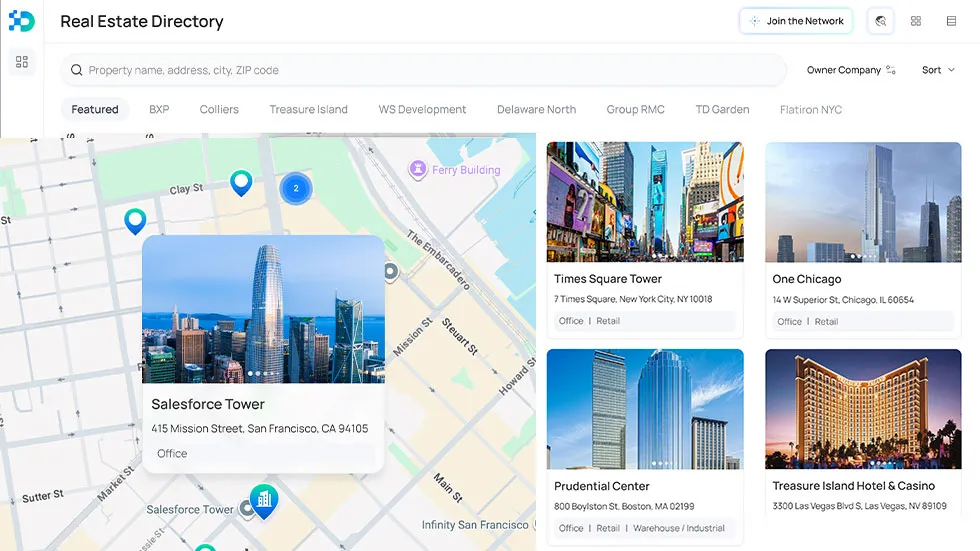
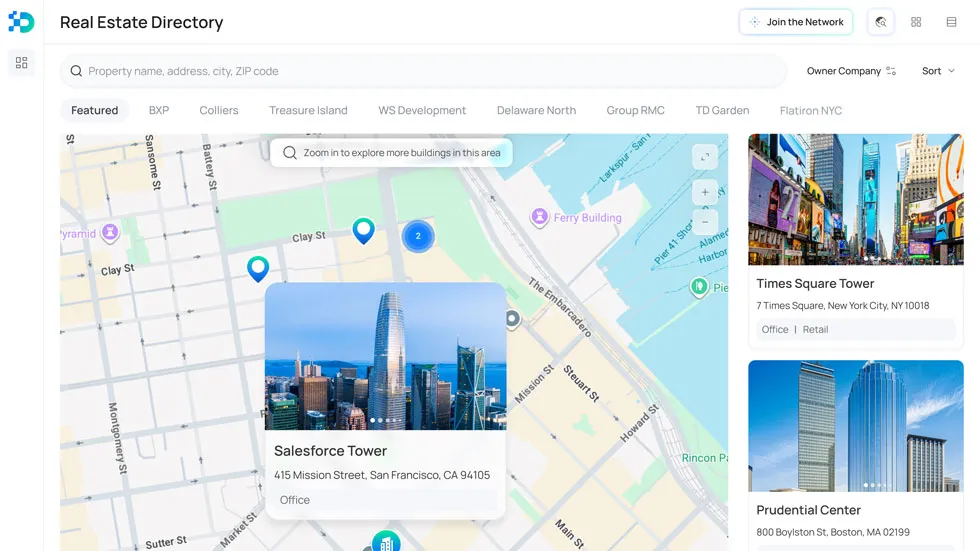
BXP has registered the digital rights for several of its buildings via blockchain on the Digital Rights Network, which was founded by Neil Mandt, a tech entrepreneur and longtime television and film producer in Los Angeles. But BXP is not alone. Owners and managers of real estate assets valued at more than $400 billion have registered with the Digital Rights Network.
Properties of note on the registry include Treasure Island Hotel and Casino in Las Vegas, the Flatiron office building in Manhattan, and TD Garden arena in Boston. BXP’s properties on the registry include the Salesforce Tower in San Francisco, 250 West 55th Street, Boston’s Prudential Tower, and One Embarcadero Center in San Francisco.
“This is a new property right,” Mandt declares. “But there has been no mechanism to record it, so if you wanted to transfer it in a sale, you couldn’t do it. Digital Rights Network is meant to be a record of ownership that allows for different transactions to take place.”
Rethinking Long-Held Real Estate Conventions
Despite growing registrations on the Digital Rights Network, the concept remains relatively novel. Many connected to the industry, from proptech providers to attorneys, are just beginning to ponder the potential impacts of digital property rights. Not only will property sellers and buyers need to determine how to treat and value the rights in a property sale, but owners will also need to include them in leases and other licenses for space in buildings, observers say.
Specifically, conventional mall leases typically prevent tenants from holding events like a fashion show in the middle of the property without landlord approval, says Steve Weikal, industry chair of the Real Estate Transformation Lab at the MIT Center for Real Estate. Mall owners and managers likewise are going to want to require consent before allowing digital promotions, he adds.
“When I’m out lecturing, I always ask, ‘Who has digital rights in their lease?” Weikal says. “We may not know what the rights exactly mean at the moment, but owners should take control of the conversation versus allowing tenants to hold a virtual event and then claim that their lease says nothing about digital rights.”

Similarly, tenants will want lease language that prohibits digital abuses by competitors, says David Blumenfeld, co-founder of NextRivet, a San Francisco-based proptech consultant primarily serving retail and mixed-use environments. An absence of digital rights protections might conceivably allow Nordstrom to overlay a digital ad on a Macy’s storefront in a shopping center, for example, or Apple to put its logo over a Microsoft sign on an office building.
“There are all sorts of conditions that tenants negotiate in the physical world, such as not being within a certain distance of a competitor, and something of that equivalence could certainly happen in the digital space,” Blumenfeld says. “We’re more or less in the Wild West of all this, and it’s going to set up some pretty interesting negotiations.”
Figuring Out the Value Proposition
Another dynamic to be determined is the extent to which digital marketing campaigns can generate ancillary income and boost the value of the physical assets, observers say, which in turn, will help establish the value of the rights themselves. The assumption is that the same characteristics that drive demand and lease rates will drive the ability of digital property rights to produce revenue—visibility, brand recognition, location, and surrounding activity, to name a few, Koop reports.
“For certain landmark or highly visible properties, particularly in gateway markets, the digital dimension of a building could create meaningful opportunities over time as immersive media and spatial technologies continue to grow,” he says. “The industry is still in the early stages of understanding what those opportunities might look like.”
However digital rights influence an asset’s income or value, Mandt’s Digital Rights Network is positioned to benefit by monetizing a property’s digital layer and taking a 5% cut of the building’s share of digital revenues.
While it’s free to record a property’s digital rights on the platform, Mandt says, the company’s fully automated marketplace will facilitate marketing campaigns and events by bringing together all the necessary players—landlords, digital content creators, media companies, brands, and intellectual property holders. Participants will also include insurance companies and municipalities or other government organizations that may have an interest in regulating AR and other digital content in certain areas, he adds.
“Soon creators will be able to go onto the platform and offer their content to all kinds of real estate that has eyeballs,” Mandt states. “Real estate owners can take what they want and the exchange with payment is recorded on blockchain.”
Embracing Disruption
Mandt’s idea to create a company leveraging new technologies began to form in 2014 when Facebook bought VR headset maker Oculus. He quickly grasped VR’s potential to disrupt the way people consumed content, including movies, TV shows, and video games. But it wasn’t until two years later that the concept of digital property rights began to come into focus, he recalls. The trigger? A report about people using their phones to locate, chase, and capture digital Pokemons placed in stores as part of the popular Pokemon GO AR game.
While Starbucks and other businesses had signed onto Pokemon GO to increase traffic, what if some landlords and property managers had no awareness that their real estate had become a gameboard? Not only were the property owners missing out on potential compensation, Mandt explains, but they were also at risk of liability if an injury or other calamity occurred on their property.
“If I came into your store without permission and started shooting a movie with 100 people, you’d walk over and say, “Who are you? The police are on their way,’” he says. “So if I’m a landlord, do I wish away something that has already been happening for 10 years and hope that it doesn’t affect me? Or do I record my property’s digital rights and put them into any contract that I enter into with another party?”
Recognizing the Importance of Control
It took Mandt several years to piece together his business plan among numerous considerations and roadblocks, including advances in the technologies required—especially the game-changing data processing and content production powers of AI—the pandemic, and property owner buy-in. But his early insight proved timely. Like Mandt, some property owners began to grapple with the growing question of digital media encroachment more than a decade ago.
In the mall world, for example, Apple and Google began to map the interiors of properties around 2014, says Blumenfeld, who at the time was with Westfield Labs, the proptech division of former global shopping center owner Westfield Group (which split in 2014 into two separate companies). In exchange for free digitization of the malls, however, Google and Apple wanted landlords to sign over their rights to the maps, he points out. But Westfield, at least, was hesitant over the unknown future implications of forfeiting those digital rights while other landlords may not have been, he recalls.
“Digital property rights are still a bit of a grey area,” Blumenfeld says. “But I think BXP’s deal and the Digital Rights Network platform signify that real estate owners today are paying attention.”