
What began as an ambitious effort to create a unified global benchmark for publicly traded real estate has become the industry’s gold standard—a critical source of market intelligence and the foundation for investment products worldwide.
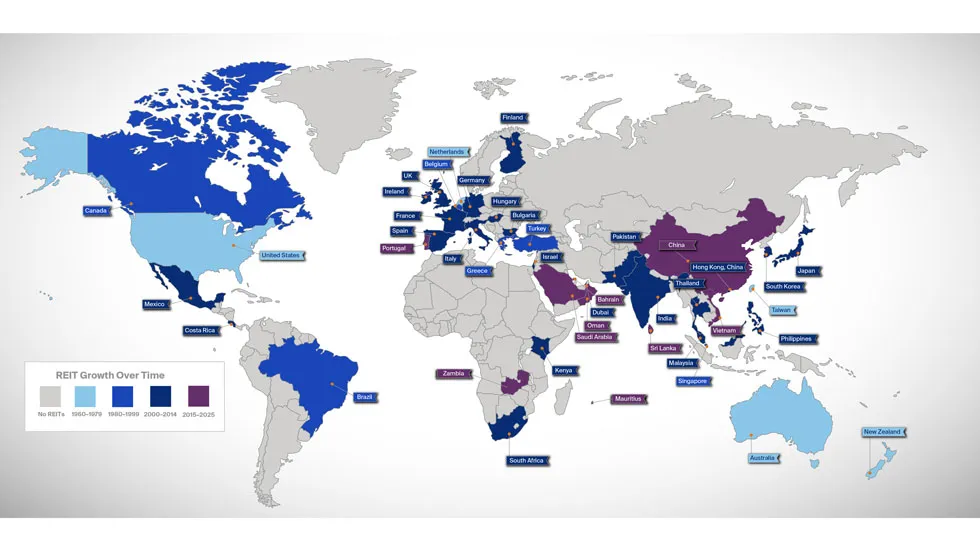
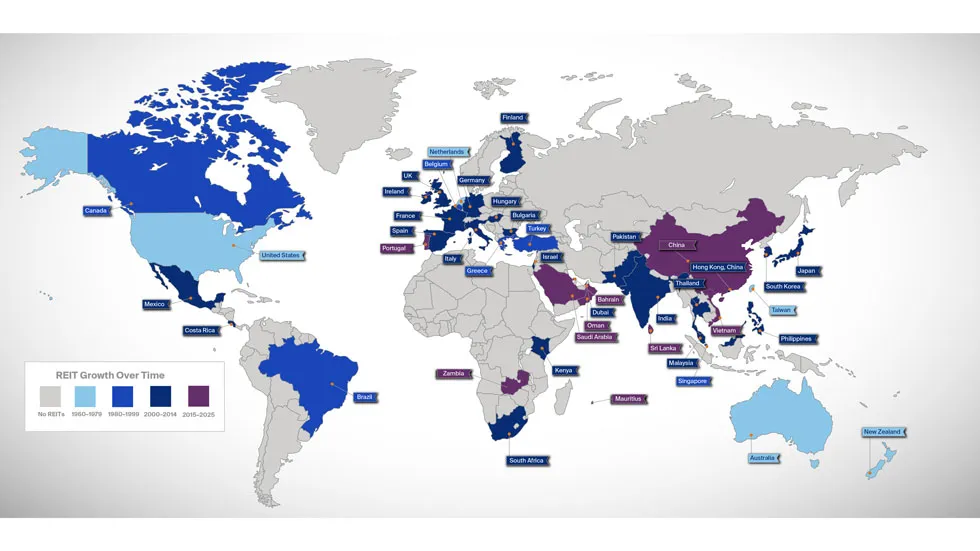
Since its launch in October 2001, the FTSE EPRA Nareit Global Real Estate Index Series has grown and evolved along with the global listed real estate industry. Today, the Index Series includes more than 500 leading companies across 40 countries, with $3 trillion in underlying property value.
“The FTSE EPRA Nareit Index is the most used index by global listed real estate investors, both on the active and passive side,” says John Worth, executive vice president for research and investor outreach at Nareit. Asset managers, pension funds, sovereign wealth funds, and ETF providers across the globe rely on these benchmarks daily. “That's why the continued development of the index has been so important, because it is the entryway for a lot of investors,” he adds.
As passive investing has grown, many ETFs, index-linked funds, and other structured products have been built on the Index Series. Currently, more than $360 billion in AUM is benchmarked to the global series.
“What should not be discounted is what this index has achieved in creating a level playing field for the wider investment community to get access to commercial real estate,” says Ali Zaidi, head of real assets & alternatives at the London Stock Exchange Group, the parent company of FTSE Russell.
The Path to a Global Benchmark
The debut of the NAREIT REIT Index (now known as the FTSE Nareit U.S. Real Estate Index Series) in 1972 laid the groundwork for all subsequent index development.
Following the launch of the Nareit Real-Time REIT Index in January 1999, which built on work over the prior decade by Chris Lucas at Nareit to update the Index from a single benchmark into one incorporating property sectors and subsectors, Nareit turned its attention to a new goal: creating a unified global benchmark for publicly traded real estate.
Under the direction of Mike Grupe, Nareit’s former executive vice president of research & investor outreach, Chuck DiRocco, then Nareit vice president of research, and Fraser Hughes at the European Public Real Estate Association (EPRA), Nareit and EPRA worked together to develop what would become the EPRA Nareit Global Real Estate Index.
Nareit and EPRA developed the ground rules, methodology, and structure of the Index, with Euronext initially engaged as the calculation engine. When it officially launched in 2001, it represented the most comprehensive benchmark for publicly traded real estate worldwide. “For the first time, institutional investors had a single, rigorous standard for evaluating real estate securities across North America, Europe, and Asia. Commercial licensing agreements were established and discussed, further validating the index’s growing institutional standing,” DiRocco said.
In February 2005, FTSE assumed responsibility for calculation and distribution, bringing global scale. The Index Series expanded its reach further with the addition of emerging markets in 2009 and new sector coverage in 2021.
“It started off as an index that gave listed real estate common language across global jurisdictions so you could invest seamlessly across different economies and different sectors,” Zaidi says. “It has evolved to become the market reference point for listed real estate across the globe.”
Propelling Industry Growth
The Index Series has played an important role in establishing listed real estate as a distinct, globally investable asset class.
As a global benchmark encompassing equity real estate worldwide, the Index Series also facilitates broader and more efficient portfolio diversification. “Real estate is recognized globally as a distinct asset class,” notes Grupe, “and the Index Series supports investment products that allow investors to build global investment portfolios that are simply more efficient.”
“By providing a consistent and transparent framework for defining the investment universe, it has enabled fund managers to evaluate opportunities across markets and sectors, while providing institutional investors with a benchmark to assess performance and risk,” says Ji Zhang, senior vice president and portfolio manager for global real estate portfolios at Cohen & Steers.
Global portfolio managers use the Index Series as a reference point for how listed real estate markets and sectors perform across economic and investment cycles. Its breadth and flexibility also allow investors to tailor their exposures across geographies and property sectors to align with their investment objectives, risk appetites, and existing portfolio allocations.
“This is particularly valuable as increasingly differentiated growth drivers, regulatory environments, and economic sensitivities across real estate sectors create opportunities for active managers to add value through research, security selection, and portfolio positioning,” Zhang says.
The Index Series stands out in what has become a more crowded field of competing investment benchmarks.
“Over the last 25 years, the FTSE EPRA Nareit Global Real Estate Index Series has evolved from one of many index series representing the listed global real estate market to the gold standard,” says Frank Haggerty, senior managing director and senior portfolio manager at Duff & Phelps. “For a specialist listed global real estate asset manager such as us, it has become the lens through which we define the investable universe for our various global real estate mandates.”
Duff & Phelps uses the series primarily to measure relative portfolio performance and assess whether its active decisions are adding value. “Beyond being a benchmark for performance, the Index Series also serves as a research tool to help us analyze long-term sector performance, monitor regional trends, and identify emerging opportunities,” he adds.
Why Index Membership Matters
The Index Series provides a bridge between listed real estate and institutional and retail investors, while bringing property companies into a globally recognized investment universe. EPRA research provides concrete evidence of the significance for European companies. Its July 2025 study, Unlocking Visibility and Performance: The Investment Impact of Joining the FTSE EPRA Nareit Developed Europe Index, examined 64 additions and 20 deletions between November 2011 and September 2024.
For additions, cumulative average abnormal returns (above those predicted by market movements) peaked at 5.7% immediately before inclusion, and a positive effect of 2.8% remained 120 trading days afterwards. Trading activity also rose markedly around inclusion.
“These findings demonstrate why index membership matters to companies seeking greater visibility and broader investor participation, particularly smaller companies building their presence in international capital markets,” says Dominique Moerenhout, EPRA CEO.
Tracking Industry Evolution
One of the series' most notable achievements is its ability to evolve alongside the listed global real estate market itself. “For an index series to stay relevant to its users it needs to remain true to its core founding principles on the one hand but also continue to be a realistic reflection of the industry it is seeking to represent,” Haggerty says.
The index has captured the industry's shift from a core focus on residential, industrial, retail, and office to a broader focus that reflects the modern economy. Investors can get data centers, self-storage, health care and other property types across the world, all in one well-structured index.
The series has also expanded to include thematic indexes, including the Developed Plus Index, the only real estate index in the world that captures the full suite of both data centers and cell phone towers globally.
“We've also made meaningful changes over the last couple of years to help make sure that some changes in real estate business models, such as having more asset management as part of the business mix, are well integrated into the index in an appropriate manner,” Worth says.
The EBITDA test is another example of evolution, shaped by subject matter experts and industry partners working together to maintain the index’s pure focus on listed real estate. The test ensures that profitability is derived from legitimate real estate activities. “It's a very micro-level review, but it ensures that for the people who are benchmarking against the index and using it for information, what they're getting is really reflective of the underlying real estate businesses,” Worth says.
Additional developments that illustrate how the Index Series has evolved to meet the industry and investors' needs include:
- The addition of emerging markets, announced in 2009, broadened the benchmark's geographic reach. It gave investors a more comprehensive framework for assessing listed property companies across developed and emerging economies.
- The FTSE EPRA Nareit Green Index Series introduced a sustainability-focused extension to the benchmark. By adjusting company weights according to characteristics such as green building certification and energy usage, it gave investors a practical way to incorporate environmental considerations into their listed real estate portfolios.
- The FTSE EPRA Nareit Global Real Estate Extended Index Series, launched in 2021, expanded coverage beyond the standard benchmark to include additional sectors such as cell-tower infrastructure and timberlands.
Collaboration that Builds on Success
The long-running partnership between EPRA, Nareit, and FTSE Russell has been key to establishing the series as the top industry benchmark. “What's great about having this partnership between Nareit, EPRA, and FTSE, is that we all bring different skill sets and knowledge bases into running the index,” Worth notes.
FTSE is a world-class indexing company with a strong governance structure, technology stack, and personnel, while Nareit and EPRA bring real estate and REIT expertise. Nareit and EPRA also gain insights and feedback from meetings with its regional index committees.
“What makes the FTSE EPRA Nareit Global Index stand out as a leading benchmark in a competitive landscape is that it is supported by EPRA and Nareit who are deeply vested in portraying this sector as accurately and transparently as possible,” Zaidi adds. “When you have the subject matter expertise on what a REIT looks like and how a REIT should be assessed, that creates the objectivity that a benchmark needs to have.”
Eligibility is informed by analysis of companies’ financial statements and the activities generating their earnings, alongside investable requirements. EPRA and Nareit contribute directly to financial eligibility analysis and property-sector classification.
“This specialist input helps investors understand the underlying real estate exposure represented by the benchmark and ensures that its construction reflects the sector’s different markets and business models,” Moerenhout says.
More Evolution Ahead
Two recent developments show how the ecosystem around the series continues to grow. In March 2024, Eurex launched futures on the Developed Europe, Eurozone, and UK indices, giving investors additional tools to adjust and hedge listed real estate exposure.
Additionally, improved climate data supports the Green indices. Differences in companies’ emissions reporting make meaningful comparison difficult, but FTSE Russell's work with Measurabl combines property information and modelling to provide more consistent assessments across companies and markets, Moerenhout points out.
Going forward, the Index Series will continue to take its cues from a growing and evolving global real estate industry. “I think what's going to come next is going to be very dependent on what comes next in commercial real estate,” Worth says. “As we see new property sectors develop, as we see new strategies develop, our job is to be responsive to those.”