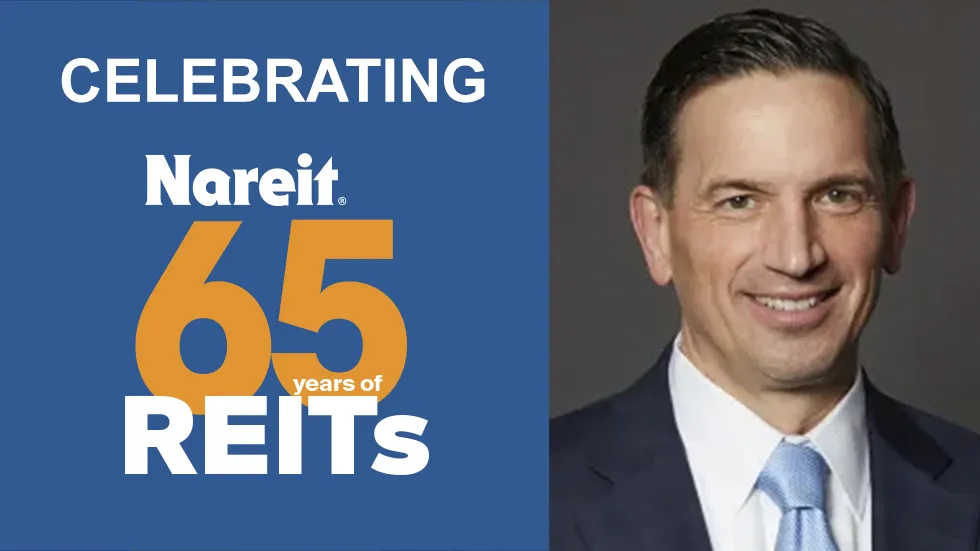
Nareit is celebrating 65 years of REITs by interviewing key figures who have helped shape the industry, including Joseph Harvey, CEO of global investment manager Cohen & Steers. Harvey joined the firm in 1992 as a REIT analyst, served as a portfolio manager from 1998 to 2016, chief investment officer from 2003 to 2019, and president from 2003 to 2024. The firm’s assets under management totaled $90.9 billion as of Sept. 30.
What would you point to as some of the main contributions REITs have made to the development of real estate investment in the last 65 years?
The REIT structure has been brilliant for investors and for owner-operators in terms of having a better way to organize their business. In the early 1990s, when there was no capital available for real estate, REITs became an instrumental vehicle to raise capital and helped many owner-operators gain access to equity to recapitalize their balance sheets and participate in a growth opportunity that was instrumental. It also helped to bring governance to an industry that had, frankly, very poor governance in the past and helped corporatize commercial real estate.
During the global financial crisis, REITs came to the rescue again, first to recapitalize themselves and then provide more equity capital to the industry. Over the years, with the evolution of the industry, it's become a better way for individual and institutional investors to invest in core or core-plus real estate and have very good returns—along with liquidity and access to many different types of businesses.
In the early 1990s, many REITs were very local or regional businesses, but due to their success and business model expansions, they became regional and then national. All along the way, REITs have helped lead the way on the cycle, generally moving before the private markets. If you look at the underlying structure of the sectors in the REIT market, you can either say they've mirrored or they've helped to lead growth in the economy by providing capital for the real estate needs of different industries.
How has Cohen & Steers implemented and evolved its REIT investment strategy to reach where it is today?
It all starts with producing great returns for our investors, both individuals as well as large institutions on a global basis. I'm proud to say that we've been an innovator, just as the REITs have been, to mirror what's evolved in the sector.
As it relates to different investment strategies, that could span total return, or income, or growth. In terms of different vehicles, that could be open-end mutual funds, closed-end funds, unit investment trusts, and now, active ETFs. But it all starts with us delivering a value proposition to our investors, which is excess returns, or alpha.
How we've generated alpha has changed over the years. In the early 1990s when I joined the firm, we had two portfolio managers, our founders Marty Cohen and Bob Steers, and two analysts, of which I was one. Our alpha was generated by going out to these different markets and meeting with companies and touring properties and getting information that nobody else had.
Fast forward to today, we're doing things like scraping websites and integrating AI into our investment process. It's all been about delivering alpha and staying ahead of the rest of the pack in terms of how we do it.
What do you see as some of the most compelling reasons to invest in REITs today?
We're at an interesting point in the real estate cycle. We've had a massive change in how real estate is valued based on interest rates going from a zero interest rate environment to a more normalized environment in response to a higher and likely persistent inflation profile, as well as growth in the economy. It's been a process for values to adjust to higher interest rates. We're not all the way through that, but it's happened more rapidly in the listed market, so we think it's a good entry point for investors.
REITs, like other value-oriented sectors, haven't performed as well as some of the more popular MAG 7-type parts of the market. It's probably time, in light of the fact that interest rates are now going to come down some more, and that we've gotten through a good part of this valuation adjustment cycle, that REITs should start to perform better.
What's really interesting as it relates to core real estate allocations is that with 65 years, and 30 years in the modern REIT era, there is a track record of performance that is compelling for all types of real estate investors. That includes pension funds, that have traditionally allocated to core private real estate. Maybe it's an allocation of 10%, but we're seeing that start to permeate in the market.
We look forward to investors creating better core property allocation results by using REITs more, and frankly using REITs in conjunction with private allocations to take advantage of the different return cycles in each segment of the market.
As we reflect on the maturation of the REIT industry at 65, what further change might lie ahead and what form could that possibly take?
This is the fun part, because when you look backwards over those 65 years, the evolution of the industry has been tremendous.
It used to be that real estate investors talked about the core four property types of office, industrial, apartments, and shopping centers. To my earlier comments about leading and helping to finance growth in the economy, today some of the largest segments of the REIT market mirror the digital economy with data centers and cell towers. It also reflects the evolution of our demographics with senior housing, for example. I think it's important for the next 65 years to think about how the economy will continue to evolve.
Maybe there's some connection with space and the REIT sector. I'm exaggerating to make a point, but some of the things I'd like to see include more and varied business models. There's been a commonality in business models to get big and be very core-like. In the old days, we would have opportunities to invest in very regional or city-specific companies that had management teams that were willing to take some more risk. I think that's something that I would like to see.
The REIT market can probably help to solve some challenges that large institutional investors have with their real estate allocations, which have become very large. Right now they're more illiquid based on where we're at in the real estate cycle, so these investors are having a tough time moving capital around. I believe that by adding more liquidity into these real estate allocations, investors can produce better results by taking advantage of the cycle.
So, my eyes are on where the economy is evolving and how can REITs play a part in providing capital to the economy. I'd also like to see a resurgence in the global REIT industry. REITs have become adopted around the world, but I think that growth has leveled out in some places.
We're starting to see some more IPO activity internationally, but it would be great to see the non-U.S. part of the market resume its growth profile like the U.S. has.
In closing, one other wish would be to see a vehicle for a sector that's related to real estate, infrastructure, that’s like the REIT structure. Of course, there are a couple of sectors like data centers and cell towers that are shared sectors within real estate and infrastructure, but we have much more capital needs in the broader infrastructure world. That includes trains, airports, seaports, and such. I think as a capital formation vehicle, we've seen what REITs have done for real estate. I would love to see Congress do the same thing for infrastructure.