During the last 30 years, REIT market capitalization has seen steady growth, with only a small dip during the global financial crisis. As shown in the chart below, market capitalization of the FTSE Nareit All Equity REITs Index has grown by more than 25 times, rising from $49.6 billion in 1995 to $1.5 trillion in 2026. This year has also seen year-to-date growth of around 13%.
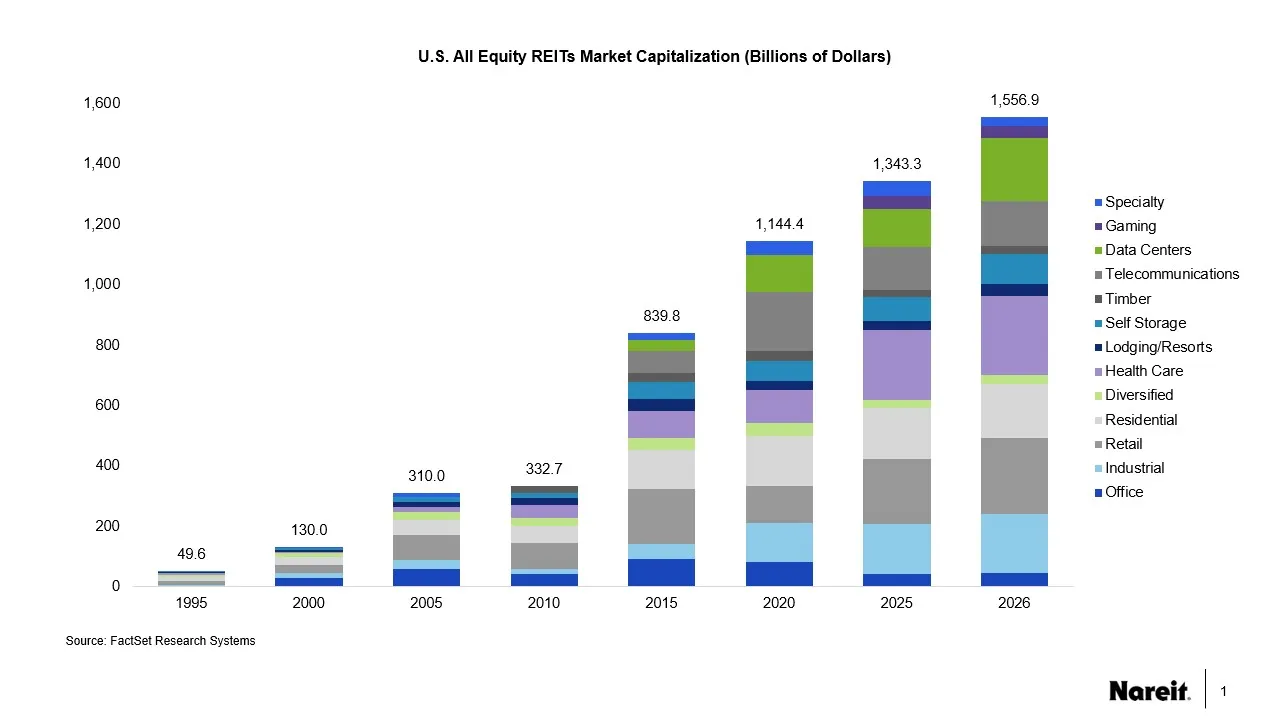
This has been an evolutionary period that has introduced new property sectors to the index, including data centers, telecommunication, timberland, and gaming. Today, new and emerging property types make up a majority of the index. As shown below, in 1995, traditional property sectors (office, retail, residential, industrial, and diversified) made up about 75% of the index’s market capitalization, but now, new and emerging sectors (data centers, health care, telecommunications, gaming, lodging/resorts, self-storage, timberland, and specialty) hold the majority of market capitalization at just over 50%.
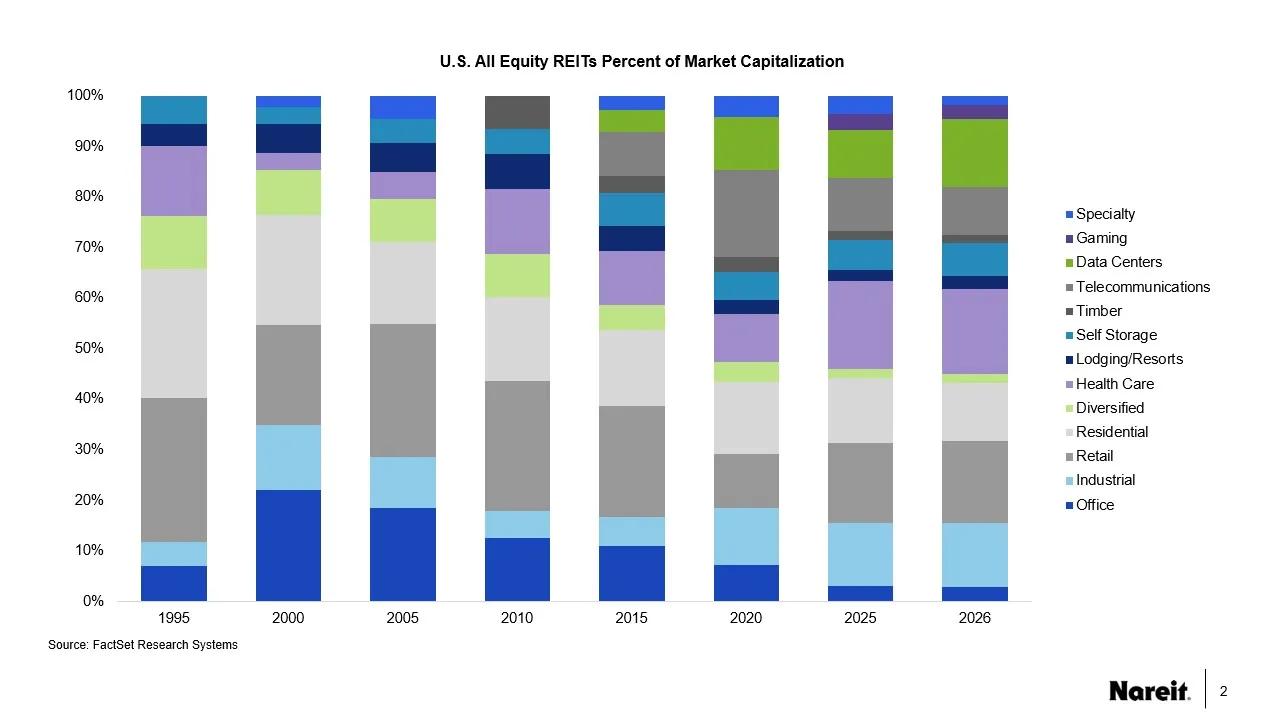
This change in the composition of the index is exemplified in the retail sector. While the sector’s market capitalization has grown considerably, rising from $14 billion in 1995 to $252 billion in 2026, its share of the All Equity REITs index has declined over the last three decades. In 1995, the sector peaked at about 28% of the index, but by 2020 hit a low of 10%. This decline in retail’s share of market capitalization is due to other sectors, mainly the new and emerging sectors, growing at a faster rate than the retail sector. As such, despite the solid growth of the retail sector, faster-growing sectors have reduced retail’s share of market capitalization.
One such rapidly growing sector is health care. In 2000, health care REITs’ market capitalization of $4.7 billion was only 3% of the index, but by 2026, the sector had a market capitalization of $261 billion, comprising just over 17% of the All Equity REITs index. A large portion of this recent growth is the result of an aging population increasing demand for senior housing and medical services.
A major addition to the All Equity REITs index was the data center sector. Data centers joined the index in 2015 and included six constituents with a total market capitalization of around $36 billion. During the next 10 years, as the sector consolidated and grew, the market capitalization rose to $127 billion, making up around 9% of the All Equity REITs index. The data center sector is positioned to continue to grow, given increasing demand from AI and more traditional data storage and interconnection-based demand. The sector recently expanded due to an IPO and an existing REIT that transformed its business to focus on data centers.
The telecommunications sector has seen similar development to that of the data center sector. Telecom REITs were added to the index in 2012 with the inclusion of a single constituent, but by 2015 the sector included five REITs with a market capitalization of $72.5 billion, making up about 8% of the index. During the next 10 years, the sector consolidated down to three REITs, but peaked as the largest property sector in 2020, making up more than 17% of the index with a market capitalization of almost $200 billion.
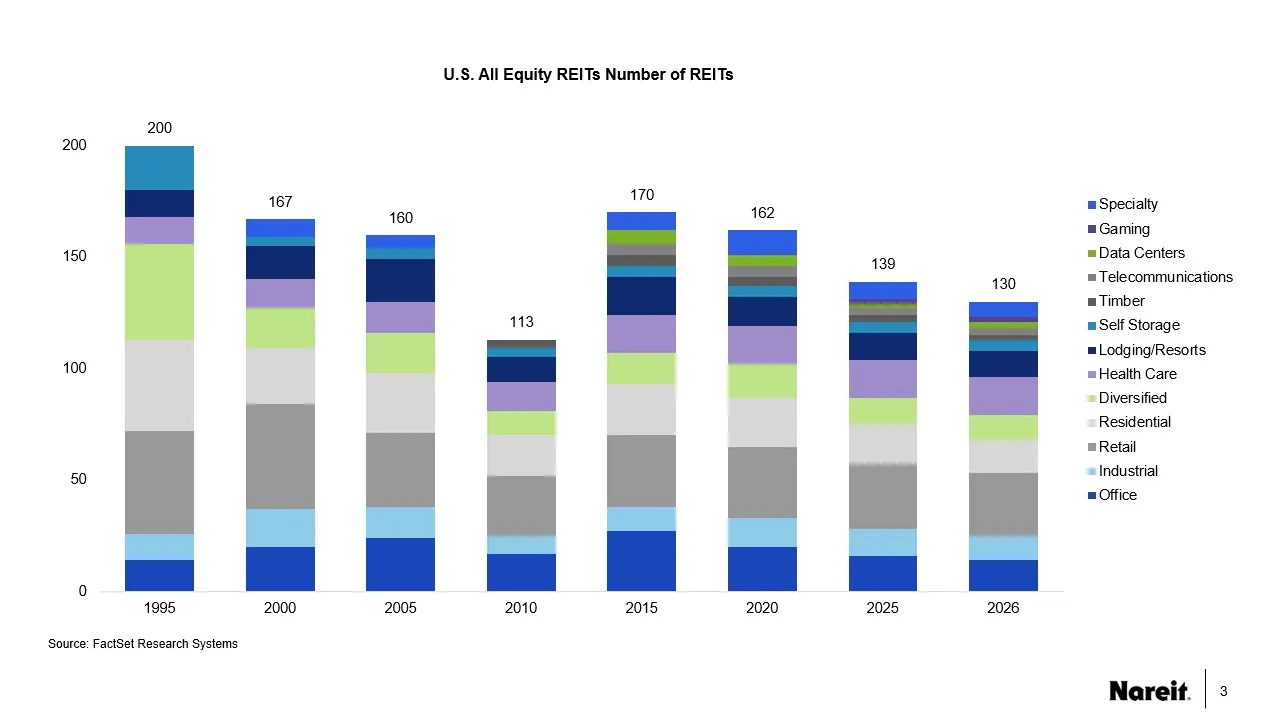
While REIT market capitalization has continued to grow, the number of REITs has fluctuated, as the chart above indicates. The number of constituents peaked in 1995 at 200 and declined to 113 in 2010 before rebounding to 170 constituents in 2015.
Today, the number of REITs is just below the 21-year average of 142. Given that the number of REITs does not trend with market capitalization, the number of REITs is not indictive of the health of the industry, as REIT market capitalization continues to rise even when the number of REITs falls. Moving into the future, REIT market capitalization will continue to grow, regardless of the number of REITs.
While the REIT landscape has changed dramatically in the last 30 years with the rise of new property sectors, traditional property sectors maintain relevance. The retail and residential sectors have seen consistent growth and currently have the second and third largest market capitalization, respectively. In addition, for the industrial sector—another traditional sector—market capitalization grew from $47 billion in 2015 to $198 billion in 2026. As such, we see that the emergence of new property sectors has complemented traditional sectors as the industry continues to grow.