U.S. public equity REITs offer a unique lens to view commercial real estate (CRE) transaction activity. Unlike many private real estate investment managers, REITs are capital allocators and generally less dependent on capital fundraising cycles. This flexibility allows REITs to pursue disciplined transaction strategies that reflect market conditions. History shows that REIT transaction activity has declined markedly during periods of persistent valuation divergence and higher capital costs, and accelerated when public-private valuations aligned and costs declined.
Despite economic uncertainty, elevated interest rates, and the continuing gap between public and private real estate values, data from Nareit’s REIT Industry Tracker show a recent increase in REIT property transactions. This trend suggests the CRE transaction market may be regaining its footing and could signal the early stages of a broad property transaction recovery.
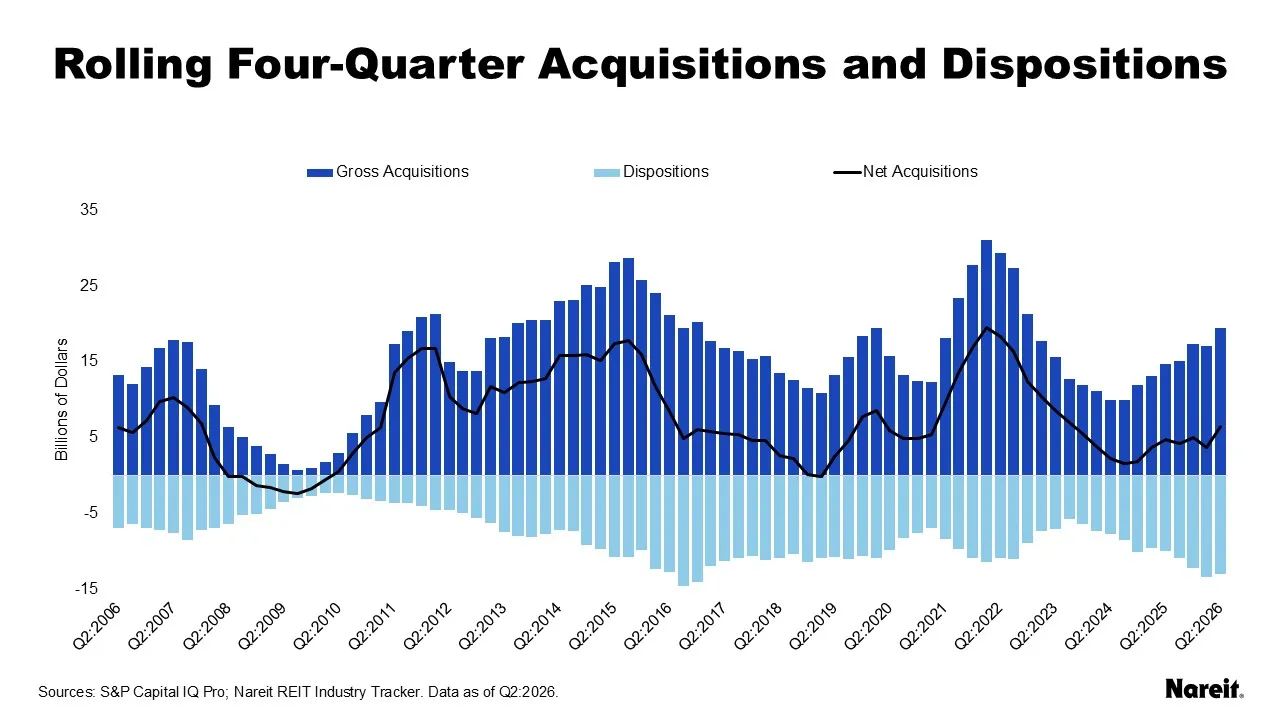
The chart above presents REIT rolling four-quarter gross acquisitions (positive values, dark blue bars), dispositions (negative values, light blue bars), and net acquisitions (positive or negative values, black line) for the last 20 years. These aggregate measures include property purchases and/or sales from all 13 REIT property sectors with the exception of timberland, which does not report its transaction activities. The net acquisitions metric was calculated by subtracting dispositions from gross acquisitions.
REITs have been active property buyers and sellers across real estate cycles. They have typically been net buyers, with the global financial crisis marking the last prolonged period when REITs were net sellers. REITs have also consistently pruned their property portfolios throughout market cycles.
After reaching its most recent nadir in the third quarter of 2024, REIT net acquisitions have trended upward with both gross acquisitions and dispositions generally increasing since that time. These movements may signal that the broader property transaction market is embarking on a return to a more normal environment.
Looking forward, broader CRE transaction activity is likely to accelerate as public and private property values become more aligned. Supported by solid operations, disciplined balance sheets, and access to cost-advantaged capital, REITs should be well-positioned to capitalize on these improving conditions and continue to grow in scale and expand their operating platforms.