Diners, Drive-Ins and Dives (“Triple D”) is a television program where host restaurateur Guy Fieri takes culinary road trips across America seeking classic “greasy spoons” that offer crowd-pleasing meals and tasty treats. Recently, the real estate valuation process has taken a journey of its own—one defined by a different “Triple D”: Divergence, Denial, and Discounts.
- Divergence: Recent data from Nareit’s REIT Industry Tracker and NCREIF’s open end diversified core equity (ODCE) funds show that the spread between REIT implied and private appraisal cap rates was 127 basis points (bps) as of the second quarter.
- Denial: With private real estate appraisal cap rates remaining near year-end 2021 REIT implied cap rate levels and only modestly above U.S. 10-year Treasury yields, appraisers and portfolio managers appear to be in a state of denial, ignoring economic and financial market realities.
- Discounts: Private core open end real estate funds developed elevated redemption queues during the current valuation divergence. Recent efforts to address exit queues and discourage further requests include tender offers, fee discounts, and management capital infusions. Reluctance to sell properties may signal an ongoing valuation problem.
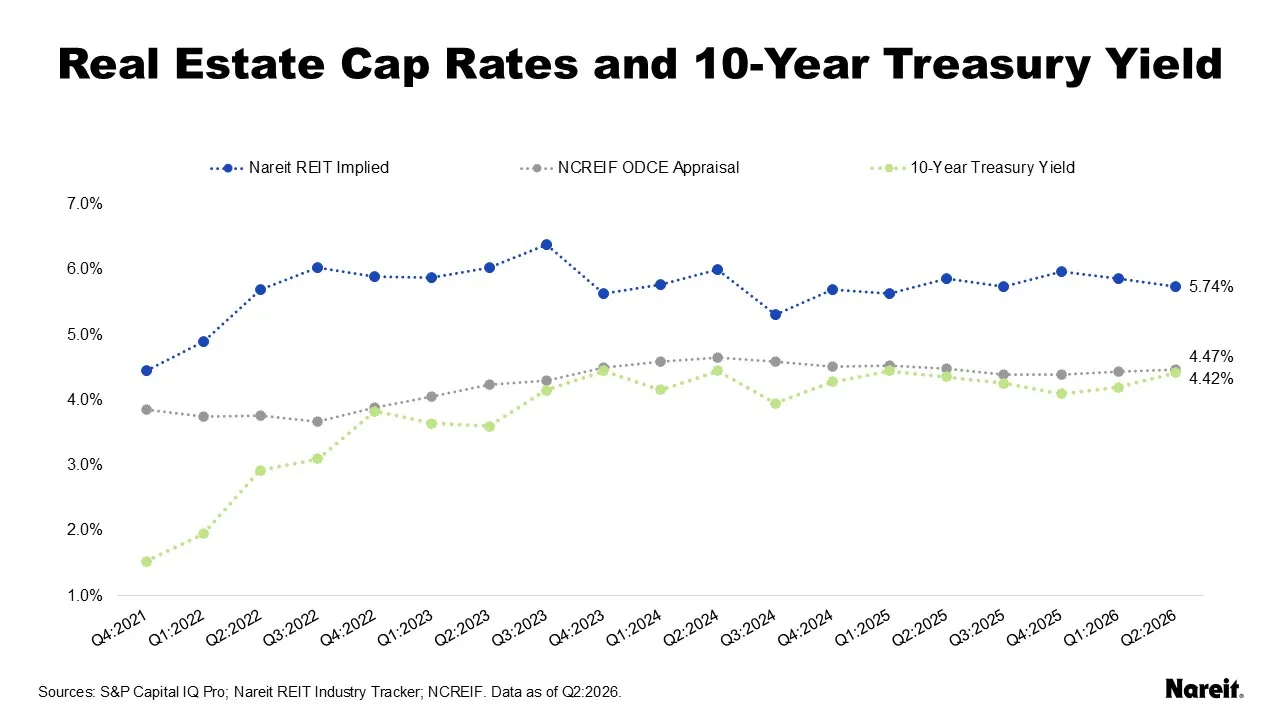
The chart above displays REIT implied cap rates from Nareit’s REIT Industry Tracker and private real estate appraisal cap rates from properties in NCREIF’s ODCE funds, as well as average U.S. 10-year Treasury yields, from the fourth quarter of 2021 to the second quarter of 2026.
Divergence Lingers
The current public-private real estate valuation divergence has continued to linger; its tenure now stands at a record 18 quarters. As of the second quarter of 2026, the REIT implied and private real estate appraisal cap rates were 5.74% and 4.47%, respectively, resulting in a gap of 127 bps.
While the REIT implied cap rate has reacted meaningfully to changes in the 10-year Treasury yield, the private appraisal cap rate has not. The appraisal cap rate appears to have reached a ceiling in the second quarter of 2024 and has remained near the year-end 2021 REIT implied cap rate level since that time. Private real estate appraisers and portfolio managers may have been hopeful that the market would come to them, but these hopes have likely been dashed by elevated, and potentially higher, interest rates.
Denying Market Realities
In addition to reaching a ceiling, private appraisal cap rates have also maintained modest spreads over U.S. 10-year Treasury yields, averaging just 22 bps since the third quarter of 2023 and only five basis points at mid-year 2026. The gap between the NCREIF ODCE appraisal cap rate and the U.S. 10-year Treasury yield has narrowed meaningfully only twice: briefly during the global financial crisis (GFC) and, more persistently, during the current public-private real estate valuation dislocation.
The narrow spreads between private appraisal cap rates and the risk-free rates underscore a prolonged disconnect between private appraised property values and financial markets. This relationship remains untenable, especially since today’s U.S. 10-year Treasury yield well exceeds the most recent NCREIF ODCE appraisal cap rate. Note that the 10-year Treasury closed at 4.76% at the end of August. At current appraised values, many ODCE properties likely could not be sold in arms-length market transactions.
Private Real Estate Fund Exit Queues & Discounts
Private core open end real estate fund redemption queues began to swell with the start of the recent public-private real estate valuation divergence. According to Accordant Investments, exit queues stood at approximately 5% in early 2022, climbed to nearly 20% by mid-2024, and eased to slightly more than 10% by early 2026. Elevated redemption queues highlight the challenges that these funds face in honoring their liquidity promises when investors want or need capital most, often creating significant investor frustration.
A recent Bloomberg article highlighted a private core open end real estate fund’s efforts to address an “elevated redemption queue” and stave off potential further redemption requests. The firm plans to offer investors in the queue a tender option at a discount to net asset value (NAV) and provide temporary fee discounts to investors with no active redemption requests. The firm and senior executives are also planning to invest additional capital into the fund “to reinforce alignment.”
These measures are costly, but appear to be more palatable—and perhaps less expensive—than other options like property sales. The fund’s unwillingness or inability to sell assets suggests that a property valuation problem may exist. When assets are properly marked to market, dispositions are typically straightforward and tend to occur without significant unexpected outcomes. Unfortunately, the prescribed efforts are likely only a temporary patch to buy some time and do not address a potentially larger, more persistent valuation issue.
Waiting for Closure
With private appraised property values still disconnected from market realities, the public-private real estate valuation gap continues to linger. Ignoring the situation will not resolve it. Some private real estate participants may find current appraisal behaviors reassuring as they bolster returns and limit volatility, but that reassurance comes with substantial costs. These practices impede the price discovery process, limit transaction liquidity, hamper investors’ abilities to redeem capital, and oblige investors to pay artificially high investment management fees.
As private appraised valuations are ultimately marked to market, the public-private real estate valuation gap is expected to narrow, and REITs are expected to benefit by outperforming their private market counterparts on a relative basis. Unfortunately, the timing of these adjustments remains uncertain.