Highlights:
- The composition of public and private real estate markets has diverged. REITs have undergone a structural transformation and now have more than 50% of market capitalization in new and emerging property sectors.
- The growth of new sectors corresponds to a fundamental reshaping of the U.S. economy driven by digitization, demographic changes, housing scarcity, and other secular trends.
- Institutional investors are increasingly using REIT-based completion strategies with private real estate to ensure their portfolios reflect today’s modern economy.
- LaSalle’s active completion portfolio strategies have meaningfully outperformed the broader REIT index and private real estate indices.
Institutional investors are increasingly implementing portfolio completion strategies, which use REITs to “complete” their portfolios, ensuring they reflect the current real estate universe. An increasingly popular example is an investor who has a portfolio with private real estate and adds or increases their allocation to REITs to gain sector diversification.
LaSalle Securities and a group of forward-looking institutional clients, including a U.S. state pension plan, offer a real-life case study of institutional investors recognizing REITs’ greater exposure to modern economic sectors and leveraging them early and quickly to generate outperformance compared to both REIT and private real estate indices.
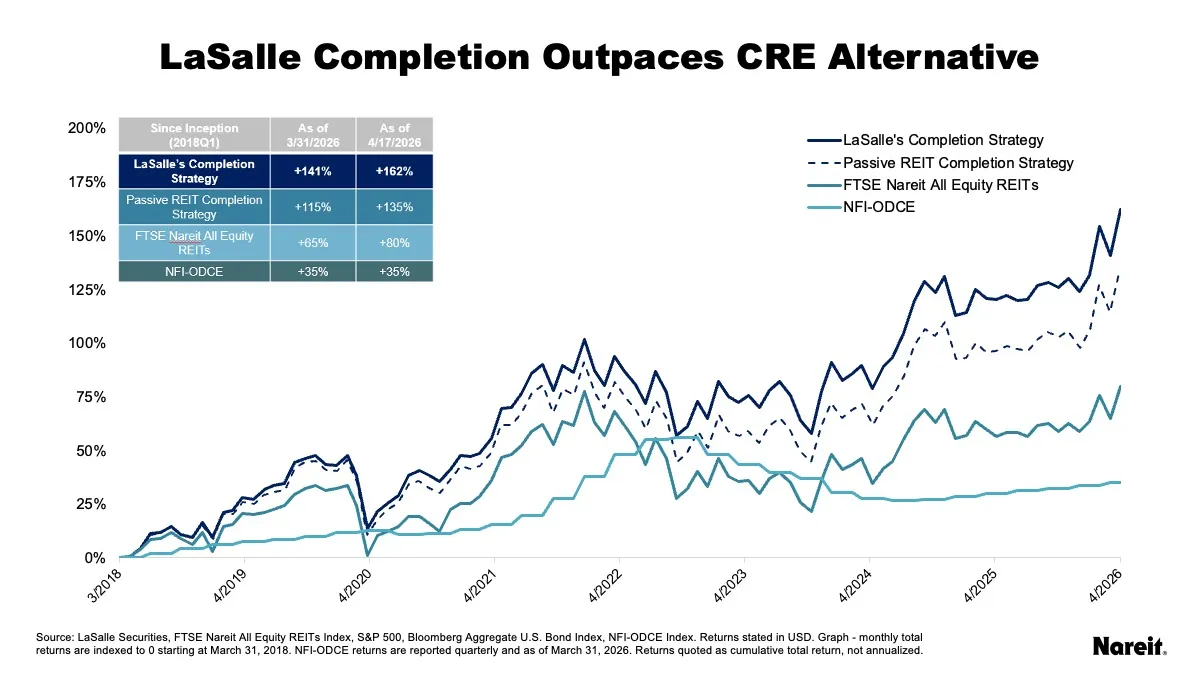
In the chart above, the passive REIT completion strategy (dashed line) materially outpaced both the broader public real estate market as represented by the Nareit All Equity REITs Index (teal line) and significantly outperformed U.S. private real estate as represented by the NFI-ODCE index (turquoise line). In this example, the completion index is comprised of the health care, data center, triple net lease, self-storage, single family housing, manufactured housing, billboards, life science, cold storage, and other specialized, emerging property types. From the first quarter of 2018 through the first quarter of 2026, the passive REIT completion strategy had a cumulative total return of 135%, compared with 80% for the broader REIT index and 35% for the ODCE index.
LaSalle Securities’ completion strategy (dark blue line), however, generated even more meaningful alpha; it returned 162% during the same period, considerably outperforming the alternative strategies. Their strategy also underscores a critical point: skilled active managers can both identify trends and add alpha to further compound advantages.
Why Completion Strategies?
In the past, public and private real estate indices had broadly the same composition. Yet over the past two decades, as public market indices have undergone a structural transformation, that relationship has broken down. The result is that private market funds and indices remain heavily concentrated in the traditional property sectors—industrial, office, multifamily, and retail—while public real estate market indices are not nearly as concentrated in them. In fact, only one-third to one-half of public real estate funds or indices are in those traditional sectors.
This change represents a fundamental reshaping of what the investable real estate asset class looks like and corresponds to a fundamental reshaping of the U.S. economy driven by digitization, demographic changes, housing scarcity, and other secular trends. The current picture of investable real estate now includes many different sectors, including cell towers, data centers, health care facilities (senior housing, skilled nursing, medical offices), self-storage, triple net lease, and niche residential formats (manufactured housing and single-family rentals).
Many of these property types were once highly fragmented markets with limited institutional ownership. REITs have played a key role in their evolution, building scale, professionalizing management, and providing investors with early access to these emerging sectors. As these property types matured and attracted capital, they became established components of the modern investable real estate universe, advancing what LaSalle describes as the “going mainstream” continuum.
Risks of Typical Private Real Estate Allocations
Although these modern sectors now represent a significant portion of the public real estate universe, they’re more difficult to access through private markets. As a result, most institutional investors have limited exposure to these dynamic property types that are integral to the 21st century economy and that will drive the next phase of real estate growth.
This means that while the breadth of private strategies has expanded beyond the typical separate accounts and commingled funds, the allocations remain weighted toward traditional property sectors in geographies worldwide. That lack of exposure creates portfolios that are structurally underweight, which is not an issue of intent, but of access.
REITs and Private Real Estate Work Best Together
These access constraints call for a deliberate response: using REITs or publicly traded real estate securities with private real estate. By using REITs to complete institutional portfolios, investors can access the entirety of today’s real estate universe to maximize diversification and returns, just as LaSalle Securities did with its completion strategy.