In today’s uncertain economy, higher inflation rates, elevated (and potentially rising) interest rates, and the strength of economic growth have become key concerns for real estate investors. While no guarantee of future results, historical data reveal that, on average, real estate has delivered solid total returns, with REITs outperforming their private market counterparts across different inflation, interest rate, and economic growth environments.
Inflation & Real Estate Performance
After a notable absence, significant rates of inflation returned to the U.S. in 2021 and 2022. Although rates later moderated, rising energy prices prompted by the Iranian conflict recently pushed headline inflation higher. The specter of high inflation has increasingly become a source of investor uneasiness, raising questions about how real estate may fare in this environment.
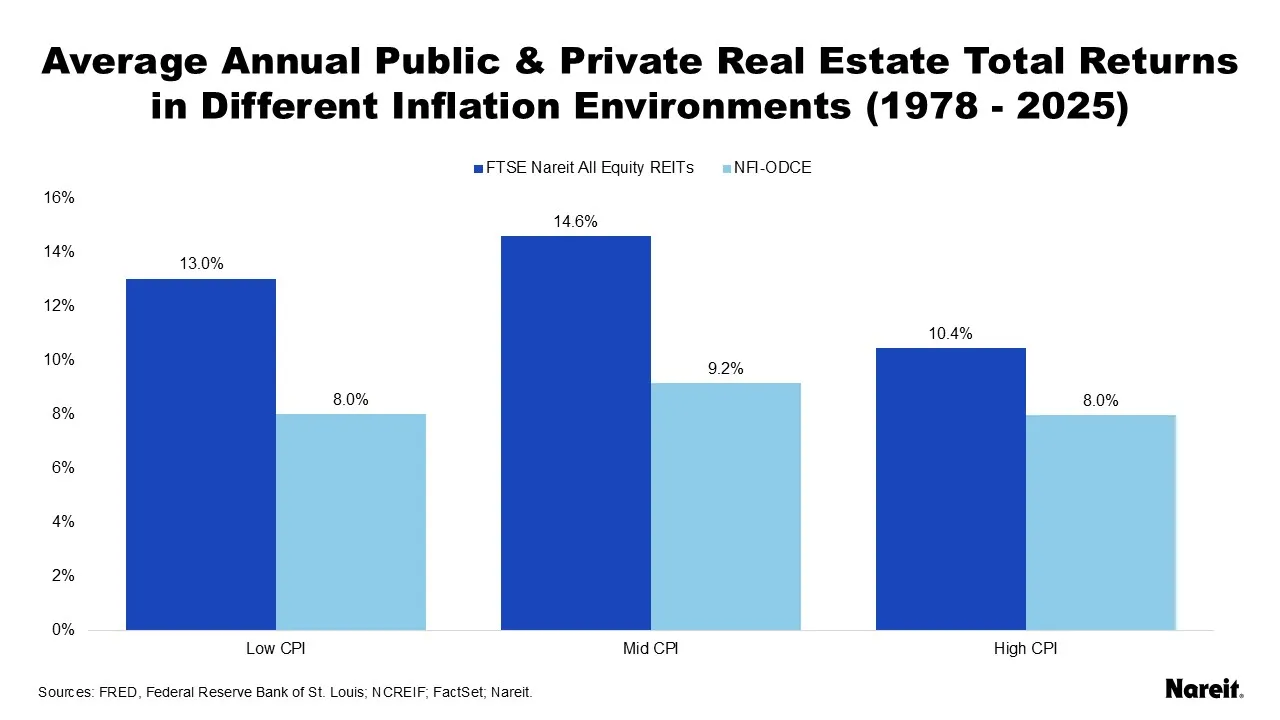
The chart above displays average annual total returns for public and private real estate in different inflation environments for the calendar years from 1978 to 2025. The FTSE Nareit All Equity REITs Index and the NCREIF Fund Index—Open End Diversified Core Equity (NFI–ODCE) are utilized to measure public and private real estate performances, respectively. The rate of inflation is measured by the calendar year percentage change in the Consumer Price Index for All Urban Consumers: All Items in U.S. City Average (CPI). Three inflation groups were created using tertiles. Rates for the low inflation group ranged from -0.3% to 2.3%. Rates were between 2.4% to 3.4% for the middle cohort and ranged from 3.5% to 13.5% for the high group.
Historical data indicate that real estate has delivered strong average performance across inflation environments. REITs outperformed private real estate in all three inflation cohorts, with average total returns topping private market returns by 5.0, 5.4, and 2.5 percentage points in the low, mid, and high groups, respectively.
Interest Rates & Real Estate Performance
Interest rate increases worry real estate investors. Their fears are rooted in the view that rising interest rates will result in rising cap rates and, all else equal, declining property values. This belief oversimplifies reality. Cap and interest rates do not move in lockstep. They are shaped by a variety of factors, including fundamentals, capital flows, and investor risk appetite.
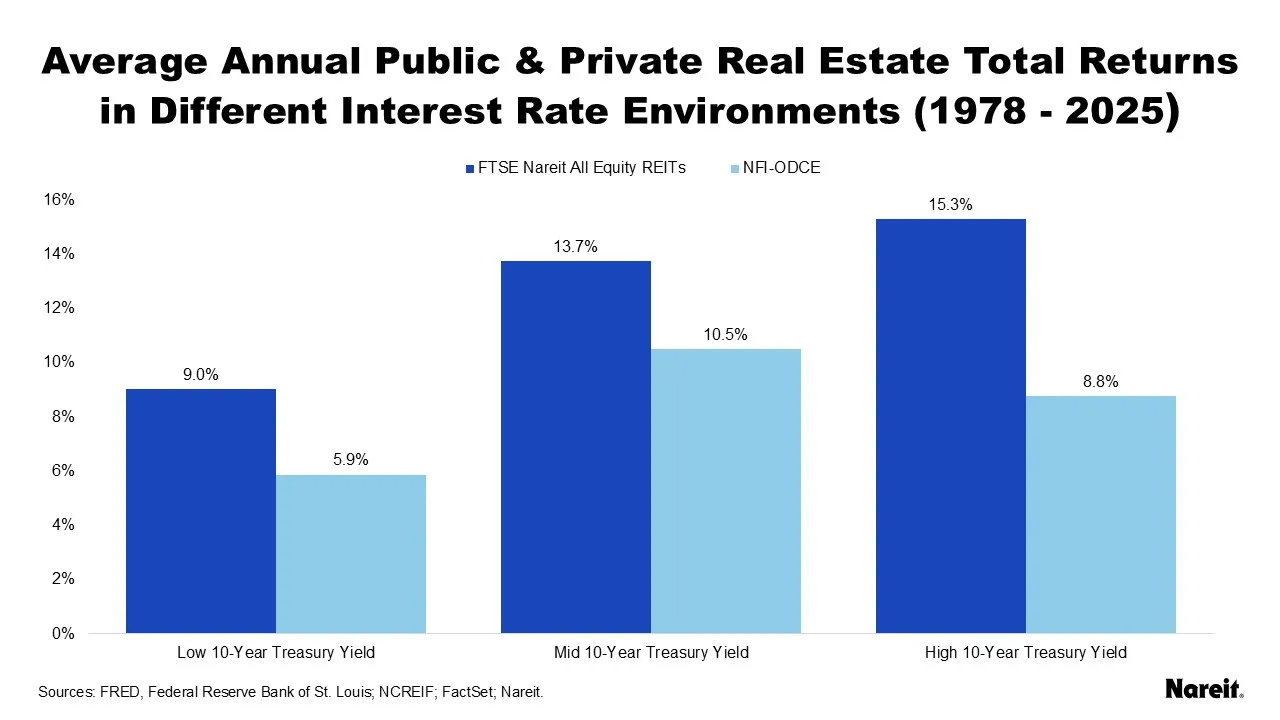
The chart above presents average annual total returns for public and private real estate in different interest rate environments for the calendar years from 1978 to 2025. Interest rates are measured by the Market Yield on U.S. 10-Year Treasury Securities Constant Maturity, Quoted on an Investment Basis. Three interest rate groups were created using tertiles of calendar year data. The yields for the low group ranged from 0.9% to 4.0%. The rates were between 4.0% and 6.6% for the middle cohort. The high interest rate grouping ranged from 7.0% to 13.9%.
On average, real estate has performed well in different interest rate environments. Moving from the low to high 10-year Treasury yield groupings, REITs experienced progressively higher average annual total returns. Note that an increasing (declining) 10-year Treasury yield tends to signal an improving (weakening) economic outlook. REITs also bested private real estate market performance in each cohort.
For investors concerned about interest rate changes, it is important to note that several factors may help offset potential property value declines related to rising cap rates. They include existing cap rate spreads, future property operational performance, underwriting exit assumptions, and time.
Economic Growth & Real Estate Performance
Assessing the state of today’s U.S. economy can be confusing. Focusing on some elements like higher fuel prices and waning consumer confidence may lead to a pessimistic outlook. Yet, concentrating on others like the recent strengthening of real gross domestic product (GDP) and limited recession fears may result in a more sanguine viewpoint. Given that economic growth is a primary driver of property performance, the current climate raises questions regarding potential risks that may impact future real estate returns.
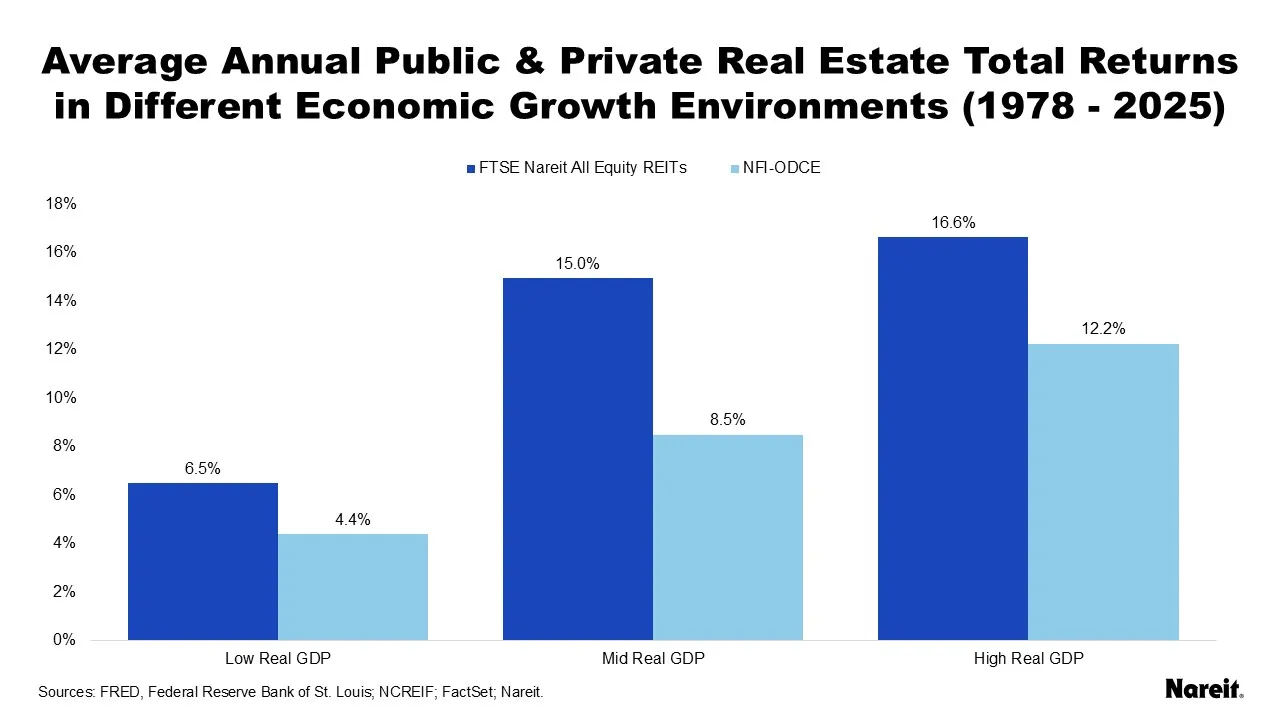
The chart above shows average annual total returns for public and private real estate in different economic growth environments for the calendar years from 1978 to 2025. U.S. economic growth is measured by the calendar year percentage change in real GDP. Three groups were created for economic growth using tertiles. Rates for the low and middle real GDP groups ranged from -2.6% to 2.5% and 2.5% to 3.5%, respectively. Rates were between 3.5% and 7.2% in the high economic growth category.
Historically, real estate average annual total returns have generally tended to be higher in stronger economic climates. Moving from the low to high real GDP growth groupings, both private real estate and REITs generated progressively higher average annual total returns, but REITs maintained a performance edge across all the real GDP cohorts.
Higher inflation, elevated interest rates, and rebounding economic growth are prompting real estate investors to pause and reassess their expectations for future returns. While past performance may not be indicative of future results, historical data indicate that, on average, real estate can thrive and post solid total returns across a variety of different inflation, interest rate, and economic growth environments, with REITs consistently outperforming their private market competitors.