A recent Nareit commentary noted that REIT operational strength has underpinned the sector’s strong investment performance. Well-structured balance sheets have also allowed REITs to continue to operate from a position of financial strength. This discipline is expected to fuel future REIT investment gains and growth opportunities.
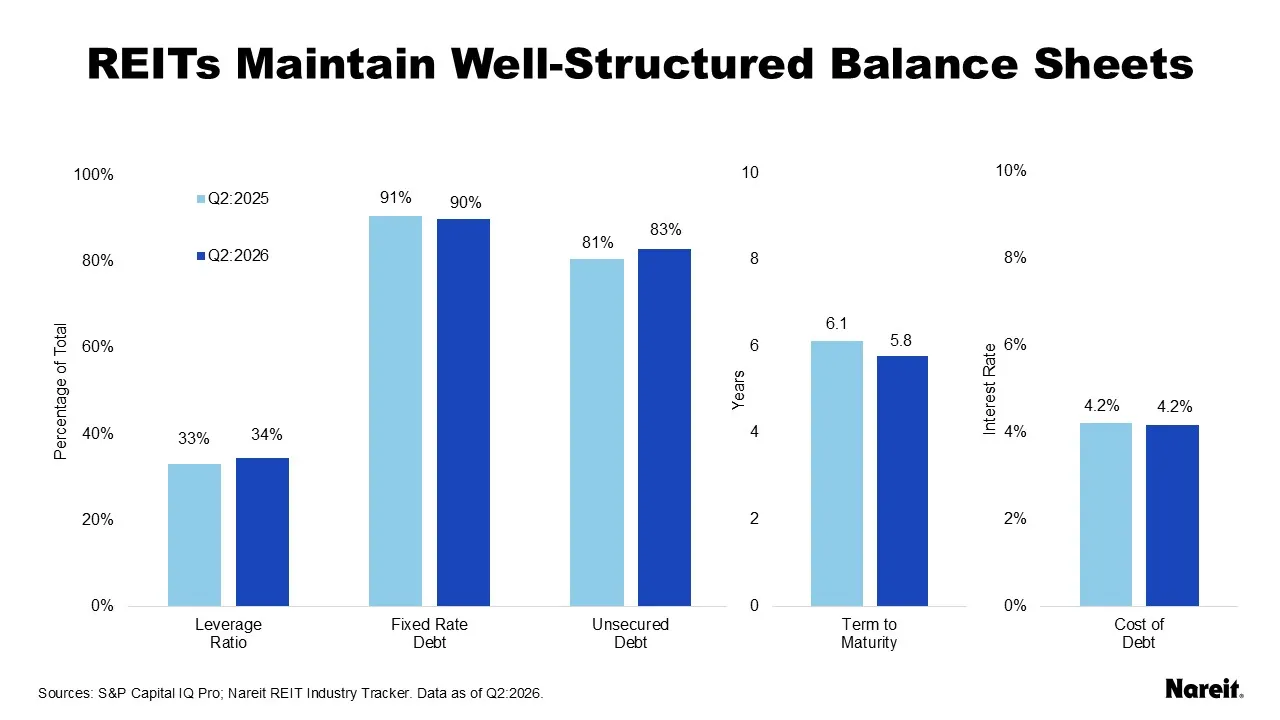
REITs Maintain Well-Structured Balance Sheets
The chart above compares REIT balance sheet metrics from Nareit’s REIT Industry Tracker for the second quarters of 2025 and 2026. The data show that REITs have remained excellent stewards of their balance sheets, on average, maintaining low levels of leverage and focusing on fixed-rate and unsecured debt with longer maturities. In the second quarter of 2026,
- Leverage ratios were low with debt-to-market assets at about 34%
- Fixed rate debt accounted for approximately 90% of total REIT debt
- Unsecured debt represented roughly 83% of total REIT debt
- Weighted average term to maturity of REIT debt was just under six years
- Weighted average interest on total debt was 2%
Balance sheet strength is increasingly important in today’s uncertain economic environment. Since midyear, interest rates have continued to rise. The U.S. 10-year Treasury yield increased from 4.4% at the end of the second quarter to 4.6% as of Aug. 25. CME Group’s FedWatch currently indicates about a 40% probability of a 25 basis point increase in the federal funds target rate at the FOMC’s next meeting on Sept. 16. Disciplined financial management has helped REITs limit their exposure to higher interest rates while preserving flexibility to meet capital needs. Access to diversified capital sources should also allow REITs to continue to grow in scale and expand their operational platforms.