In the fourth quarter of 2025, CoStar data showed that fundamentals across the four traditional property types were still marked by supply-demand imbalances, but signs of stabilization were also evident. Each sector’s ability to make continued progress in moving toward its equilibrium will likely shape the strength of its property operational gains in 2026.
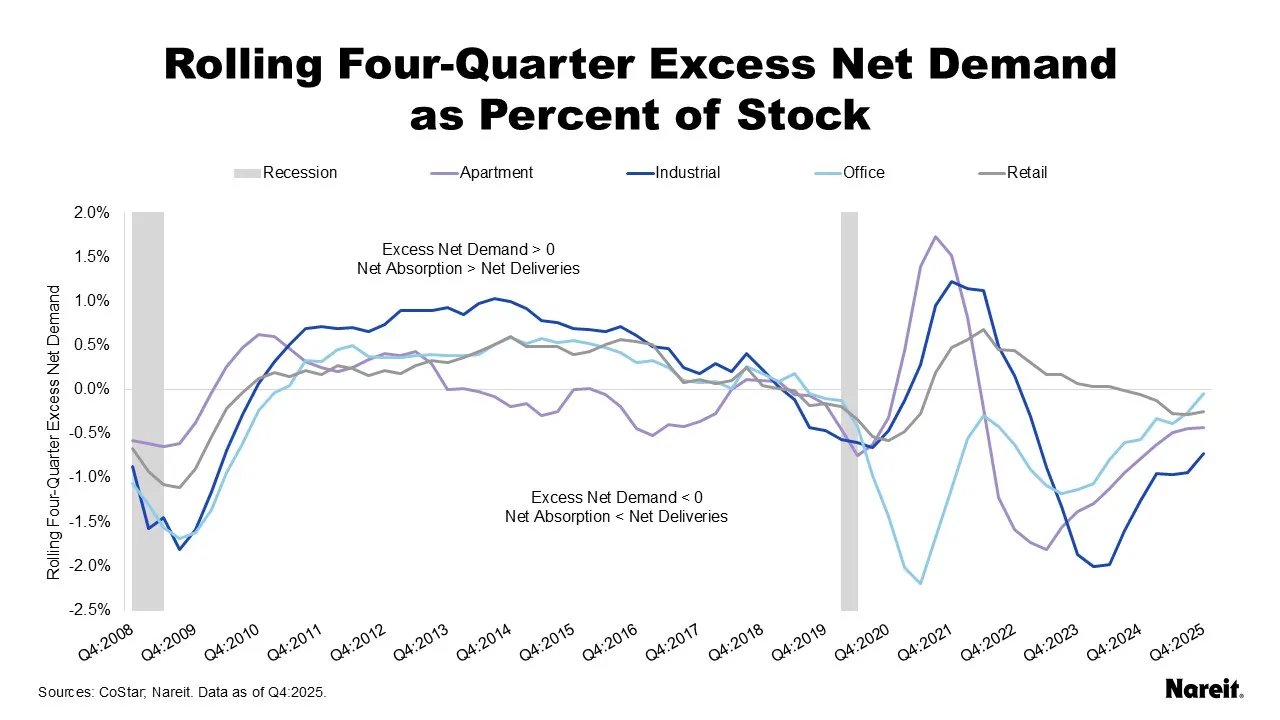
The chart above shows rolling four-quarter excess net demand as a percentage of existing stock by property type from the fourth quarter of 2008 to the fourth quarter of 2025; it also displays U.S. recessions. Although net absorption fell short of net deliveries for each of the four traditional property types in the last quarter of 2025, each sector’s upward trajectory indicated continued progress toward balancing demand and supply. With its near-zero excess net demand, office fundamentals were essentially balanced. Retail maintained a modestly negative excess net demand. Demand and supply imbalances were widest for industrial and apartment, but both sectors have made significant strides in narrowing their gaps.
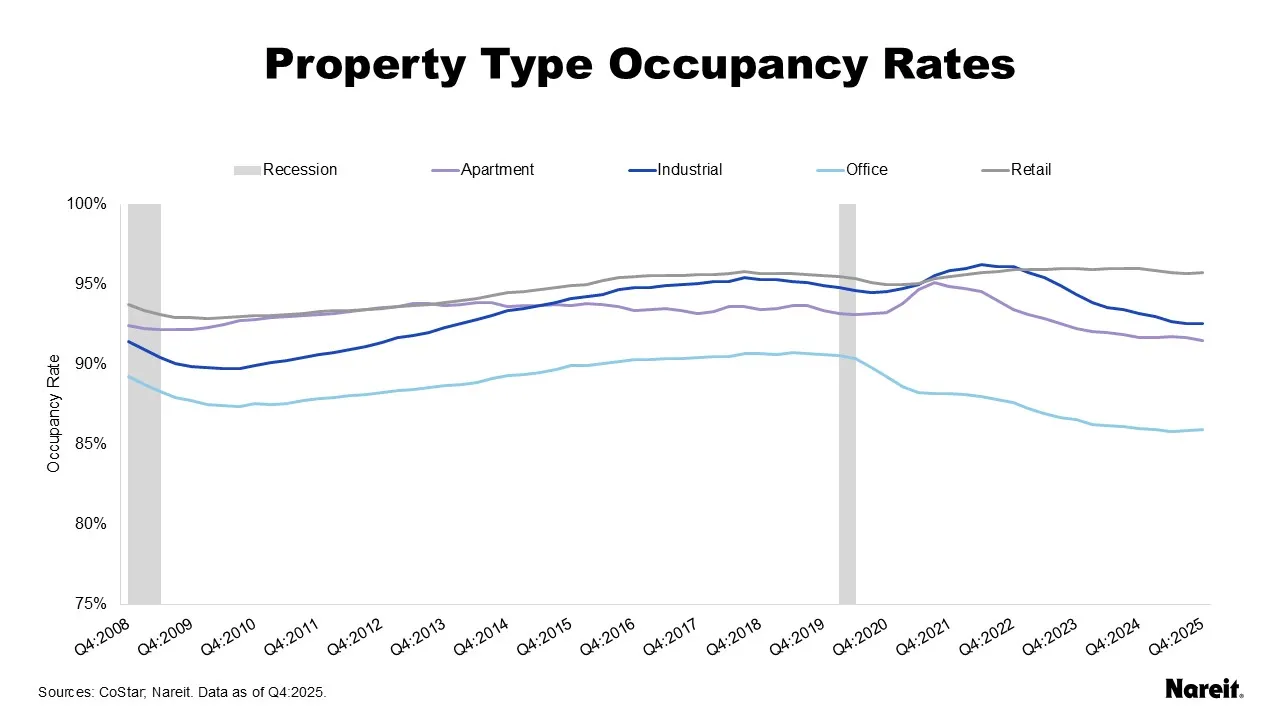
The chart above depicts occupancy rates for the four traditional property types, as well as U.S. recessionary periods, from the fourth quarter of 2008 to the fourth quarter of 2025. Retail occupancy has generally maintained a consistent level for the past few years; it was 95.7% in late 2025. Industrial, apartment, and office occupancy rates have followed downward trajectories, but have shown recent signs of stabilization. As of the fourth quarter of 2025, the industrial and apartment occupancy rates were 92.6% and 91.5%, respectively. Apartment occupancy has reached its lowest level since 2000. The office occupancy rate was 86.0%, posting its second quarterly uptick after a prolonged downturn.
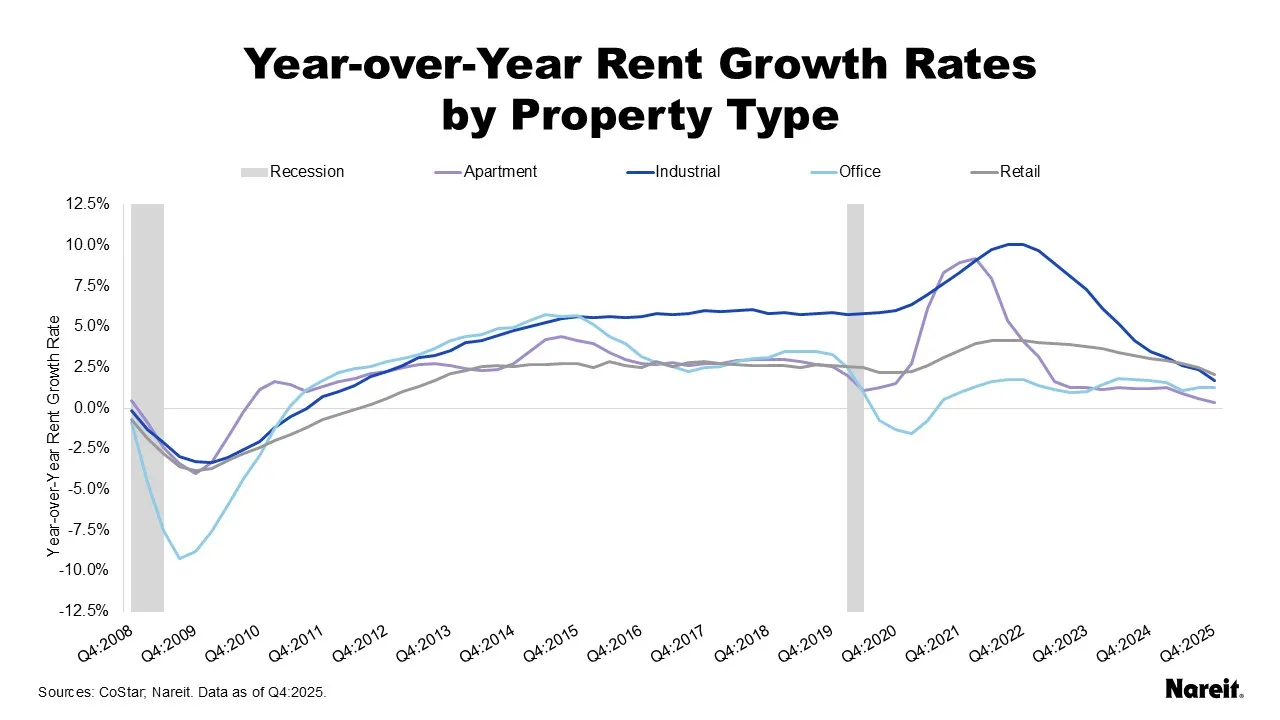
The chart above presents year-over-year rent growth rates by property type from the fourth quarter of 2008 to the fourth quarter of 2025, including U.S. recessionary periods. After reaching double-digits in 2022, industrial rent growth dropped to 1.7% at year-end 2025. The apartment rent growth rate reached a high of 9.2% in early 2022; it has since plunged to 0.4%. Retail followed a more modest downward trend, declining from 4.1% in 2022 to 2.1% in late 2025. Despite historically low occupancy rates, office continued to maintain consistent and positive rental gains, posting annual rent growth of 1.2% in the last quarter of 2025. Although rent growth rates have slowed or leveled off, they remain positive across the four traditional property types.
While today’s property market tends to be characterized by supply–demand imbalances, declining/low occupancy rates, and moderating/low rental growth rates, signs of stabilizing fundamentals have started to emerge. As markets move toward their equilibriums, both occupancy and rental growth rates will likely rise, benefiting property operational performance.