Nareit tracks quarterly investment holdings for the largest actively managed real estate investment funds focusing on REIT investment for insights into expert investor sentiment. In the second quarter of 2026, health care maintained its top spot in the funds at 21.1% of assets under management (AUM). The sector saw the largest quarterly and yearly increases of all property sectors, bringing it to 111% of its index weight in the funds.
In contrast, telecommunications saw the largest year-over-year declines, though it continues to be the most overweight sector at 134% of its index share. Gaming continued its decline in share of the funds, dropping to just 0.9% of assets, the second smallest allocation after diversified.
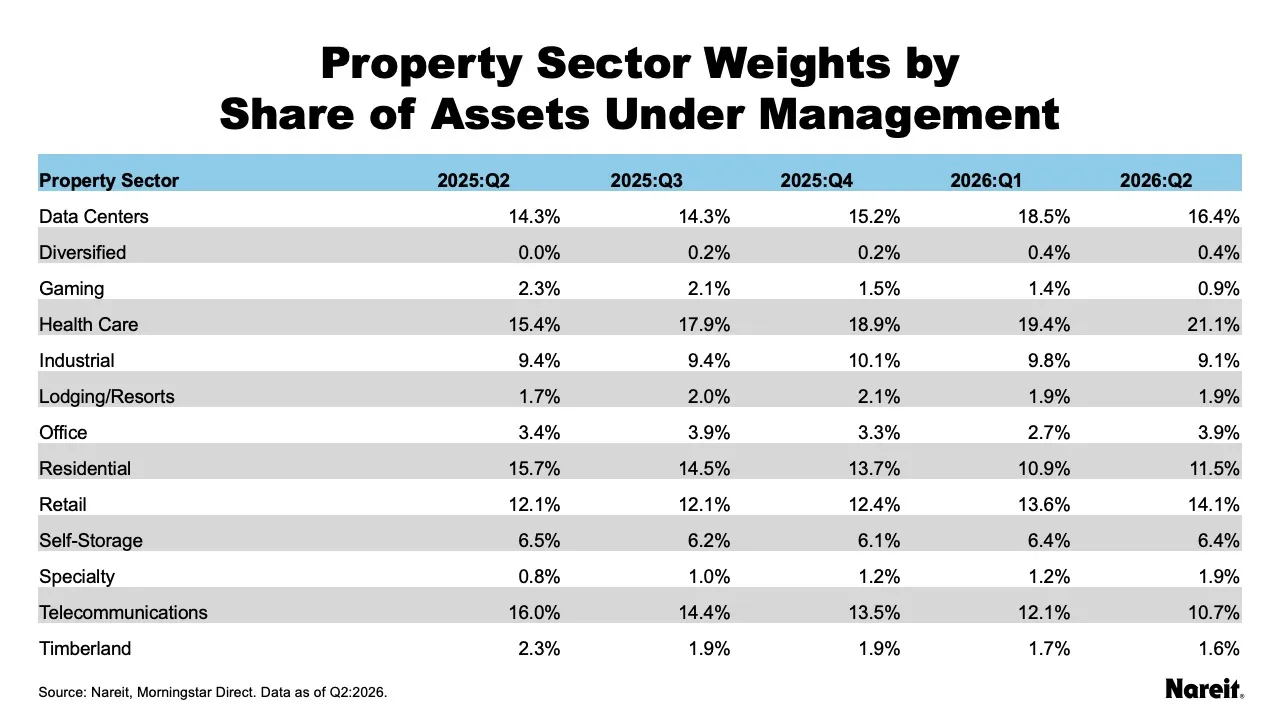
The table above shows the share of each equity REIT property sector by AUM.
- Health care (21.1%), data centers (16.4%), and retail (14.1%) maintained their spots as the three largest allocations.
- Residential (11.5%) and telecommunications (10.7%) followed, claiming fourth and fifth, respectively.
- Lodging/resorts moved out the bottom three, tying with specialty at 1.9%.
- Timberland (1.6%) and gaming (0.9%) rounded out the bottom, with diversified (0.4%) remaining in last place.
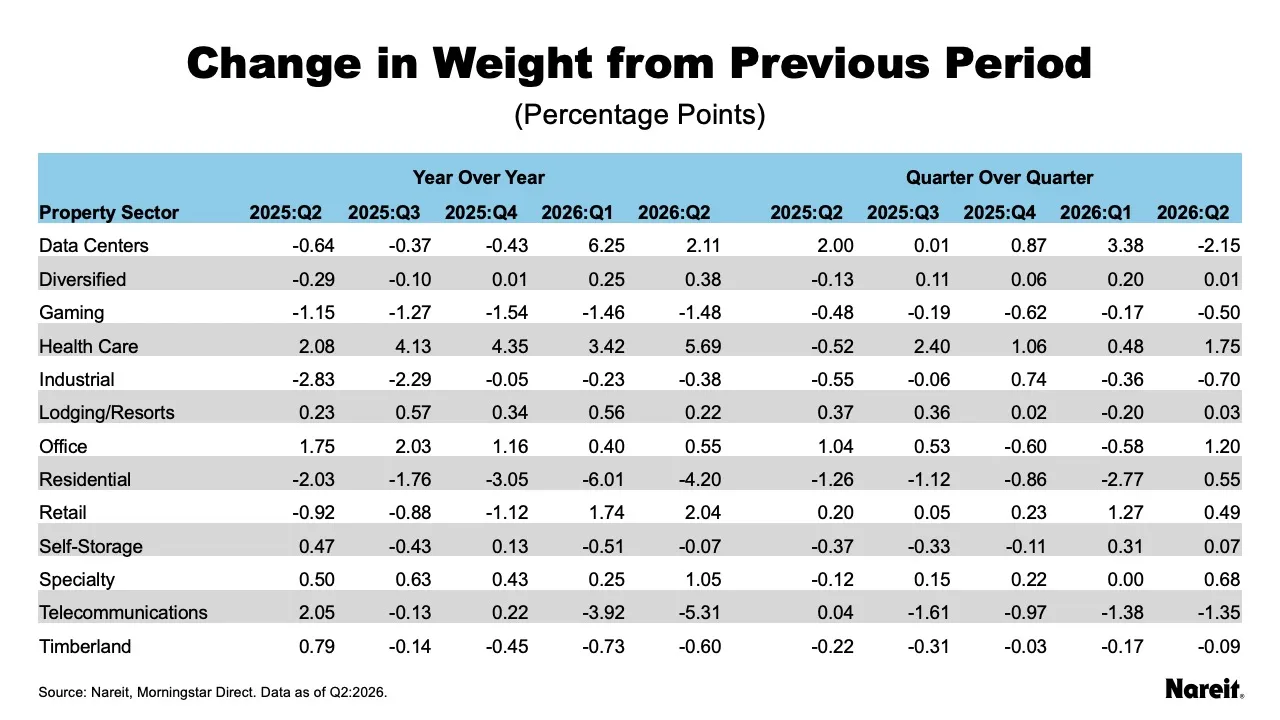
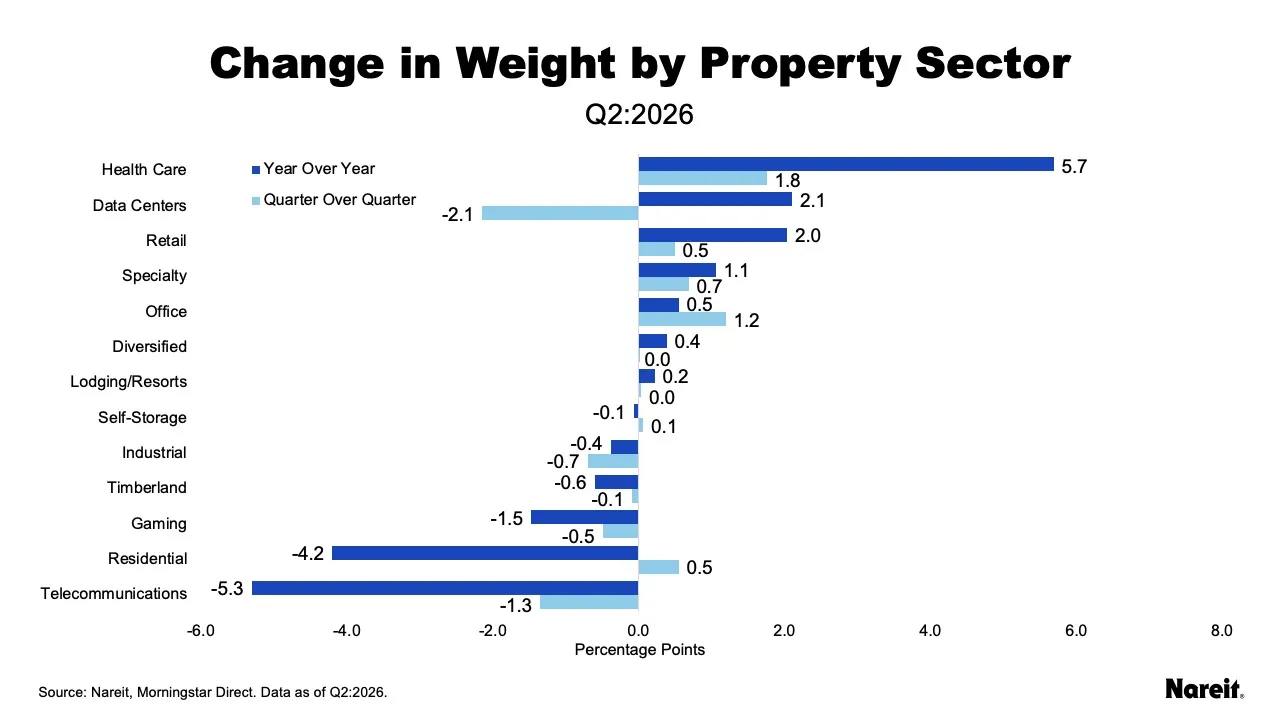
The table and chart above show the change in property sector asset share by quarter and from the previous year.
- Health care led sector gains. It had the largest year-over-year and quarter-over-quarter gains in weight of 5.7 and 1.8 percentage points, respectively.
- Retail, specialty, and office also gained share. Retail was up 2.0 percentage points since last year and up 0.5 percentage points since last quarter. Specialty increased by 1.1 percentage points year-over-year and was up 0.7 percentage points quarter-over-quarter. Office saw a 1.2 percentage point increase compared to last quarter and was up 0.5 percentage points from the second quarter of 2025.
- Data centers remained up annually despite a quarterly decline. After several quarters of increases, data center asset share fell 2.1 percentage points, but remained 2.1 percentage points higher than a year ago.
- Gaming and telecommunications continued to lose share. Gaming declined for the ninth consecutive quarter, falling 0.5 percentage points during the quarter and 1.5 percentage points annually. Telecommunications had both quarterly and annual declines, down 1.3 and 5.3 percentage points, respectively.
- Residential reversed its quarterly trend. After four consecutive quarters of declines, residential asset share increased 0.5 percentage points during the quarter, although it remained down 4.2 percentage points from a year ago.
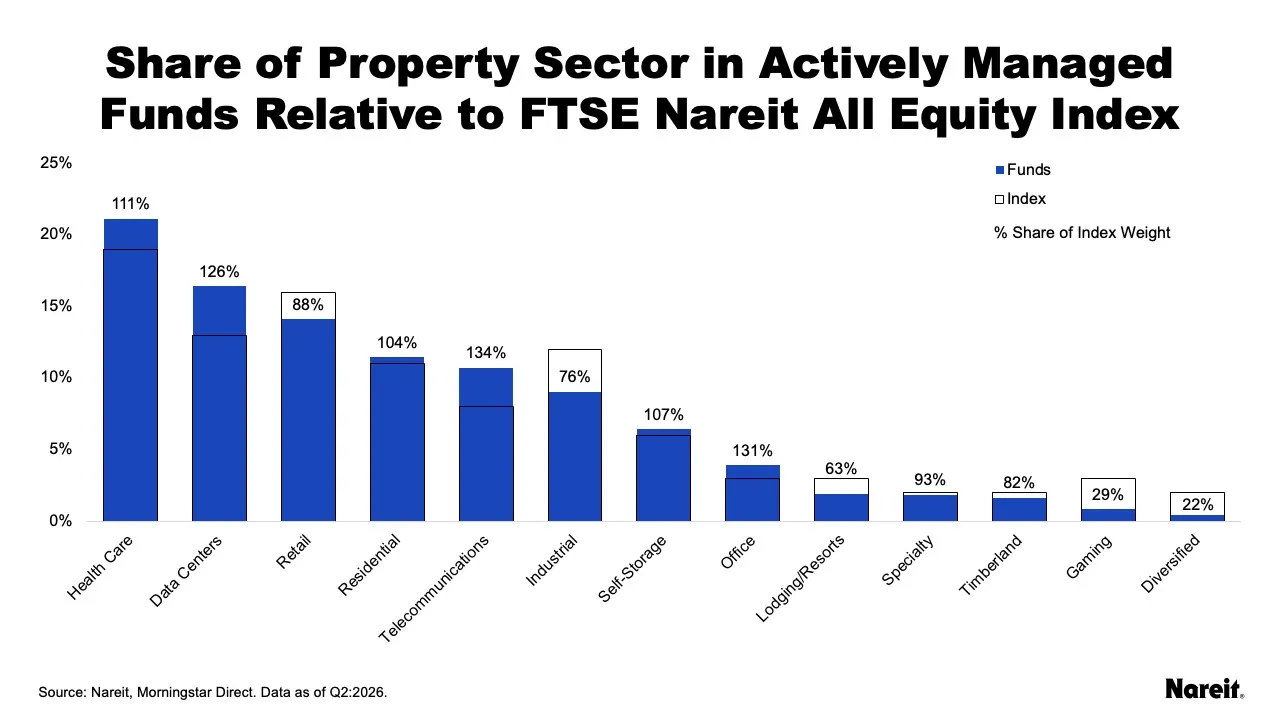
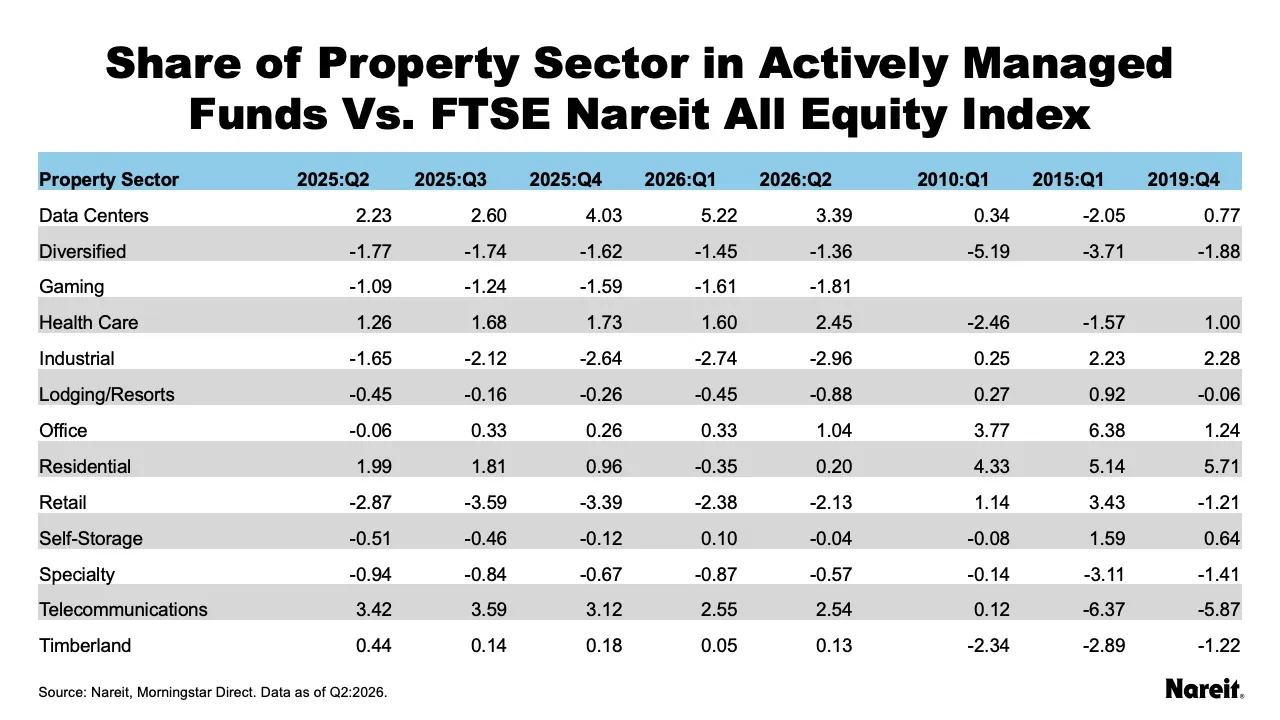
The chart and table above compare the weight of the sectors in actively managed funds to the weight of the sectors in the FTSE Nareit All Equity index.
- Telecommunications and data centers were the most overweight relative to their index shares. Telecommunications became the most overweight sector relative to its index share, with active funds holding 134% of the sector’s index weight. At 2.5 percentage points, it had the second highest overweight in absolute terms. Data centers remained the largest absolute overweight at 3.4 percentage points, although its relative overweight declined to 126% of its index weight.
- Health care and office weights continued to increase. Health care (111%) and office (131%) remained overweight relative to their index weights. Their absolute weights increased steadily throughout the year, reaching second quarter highs of 2.5 percentage points for health care and 1.0 percentage points for office.
- Residential moved back into overweight territory. It reached 104% of its index weight in the second quarter, representing a modest 0.2 percentage point overweight.
- Retail, industrial, and specialty remain underweight. Retail and industrial stood at 88% and 76% of their respective index weights. Specialty improved from the beginning of the year but remained underweight at 93%.
- Gaming, lodging/resorts, and diversified were the most underweight relative to their index shares. Gaming continued to decline, reaching 29% of its index weight. Lodging/resorts and diversified also continued to decline relative to the index, ending the quarter at 63% and 22% of their respective index weights.
Note that one of the 24 funds had not reported second quarter data for this analysis.