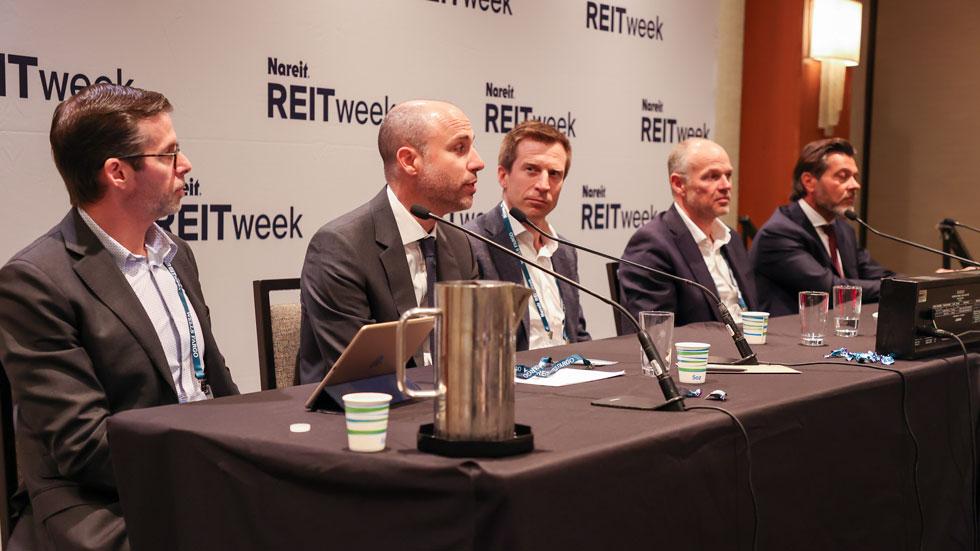
CEOs of four leading European REITs across multiple sectors provided first-hand insights into market trends, investment potential, and strategic opportunities in Europe’s listed real estate sector during a panel discussion on the first day of Nareit’s REITweek: 2026 Investor Conference.
Cedrik Lachance, director of research at Green Street, moderated the panel, which featured: Giacomo Balzarini, CEO of PSP Swiss Property AG (SWX: PSPN); Simon Carter, CEO of The British Land Company PLC (LSE: BLND); Joe Lister, CEO of Unite Group PLC (LSE: UTG); and Beñat Ortega, CEO of Gecina (Euronext Paris: GFC).
The panel focused on the ways in which European REITs are positioning themselves in today’s interconnected global market, given structural shifts in occupier demand, urban regeneration, and sustainability driving long-term value.
PSP Swiss Property focuses on prime office and high street retail properties in major cities across Switzerland. British Land concentrates on London office campus assets and UK retail parks located outside major towns and cities. Unite Group is a provider of student accommodation at UK universities, and Gecina concentrates on prime office assets in Paris.
The CEOs highlighted specific developments within their individual market spheres.
Ortega explained that Gecina has seen significant market rent growth in the last four to five years, noting that Paris remains a diverse, global city with a well-developed transportation system that provides a strong draw for companies to locate in the nation’s capital. He also noted that for Gecina, the cheapest cost of capital has come from selling certain assets and reinvesting in areas where offerings are scarce.
Balzarini noted that PSP Swiss Property operates in a low inflation, low interest rate environment, with a 97% occupancy rate for its office portfolio. While PSP Swiss Property could push high street retail rents 20%-25% higher, rent increases are more constrained on the office side, he noted.
British Land, meanwhile, has just posted a record year of leasing for its London office campus and retail park platforms. Net absorption in London office is at a 20-year high, Carter noted, and the REIT is seeing good pricing power, especially for new deliveries. On the retail side, Carter described the segment as a “winner” post-pandemic due to the affordability of rent and ease of access for customers. Occupancy in the retail space is around 99%, Carter said.
Unite Group’s Lister discussed disruption in the student housing market over the last two years due to changes in UK migration rules and cost of living challenges. The latter has prompted the REIT to shift its focus to top tier universities rather than lower tier, he explained. Unite is currently active with the top one third of UK universities and is looking to move that share to 80%. “It’s about repositioning and working with universities we think will continue to grow,” Lister said. He also discussed Unite’s recent purchase of Empiric Student Property, marking a significant step forward in its strategy to support students throughout their entire university journey.