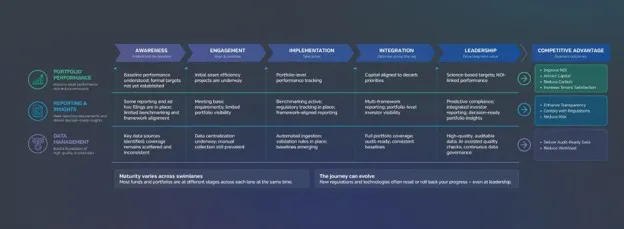
Sustainability is redefining real estate performance. What once lived in an annual report now shapes how assets are financed, insured, leased, and valued, turning a reporting exercise into a source of competitive advantage. For REIT leadership teams, success means each year’s work improves the next year’s performance, in both NOI and sustainability metrics.
The pressures behind that shift are well documented. U.S. commercial real estate insurance premiums have risen 88% over the past five years,according to JLL. Building performance standards continue to expand across major cities, and in some markets non-compliance carries six- or seven-figure annual penalties at the asset level. Lenders and investors are pricing physical and transition risk more directly into their decisions. In listed real estate, that performance now affects index weighting through theFTSE EPRA Nareit Green Index Series, which rewards companies with stronger energy, emissions, and certification profiles.
At the same time, sustainability and asset management are converging. Energy costs, regulatory exposure, and climate risk now bear directly on NOI, hold-sell decisions, and capital planning, so the data sustainability teams manage is increasingly the data asset managers need. The organizations moving fastest treat the two as one discipline, working from a shared view of how each asset performs. Most are doing it with fewer people and tighter budgets, which is why the program has to be practical, defensible, and repeatable across the portfolio.
Three capabilities that compound
Measurabl has worked with more than 1,000 real estate organizations, and the ones pulling ahead build strength in three areas, each answering one question:
- Data Management (Can I trust my data?): The information that quantifies an asset’s performance sits in bills from multiple utilities, leases, compliance filings, engineering reports, loan documents, appraisals, and more, most of it unstructured PDFs or files. Leading organizations turn it into investment-grade, audit-ready data that is complete, traceable to its source document, and kept that way through continuous governance.
- Reporting & Insights (Can I explain my performance?): Benchmarking, regulatory tracking, and multi-framework reporting give every stakeholder portfolio-level visibility. The strongest programs pinpoint which assets underperform, where energy, water, and waste costs are rising, and where exposure to building performance standard penalties is growing.
- Portfolio Performance (Can I improve outcomes?): Targets and portfolio-level tracking turn insight into action. Leaders build sustainability performance into asset management, shaping the capital planning, hold-sell, and leasing decisions that lift NOI.
The three build on one another. Insight depends on reliable data, and good decisions depend on reliable insight. Each cycle of better data and sharper analysis carries into the next, which makes the advantage hard for competitors to copy.
The same foundation powers AI
According to CRE Analyst's AI in Commercial Real Estate Report (Summer 2026), 96% of CRE professionals use AI, yet 51% say trust is a barrier to greater adoption. The gap is rarely the model; it is the data underneath it. Teams with verified, traceable data are the ones moving AI from drafting summaries to informing compliance and capital decisions.
See where you stand
Measurabl's Sustainability Journey guide maps each capability across five stages, from Awareness to Leadership. Its self-assessment quiz shows where your organization stands and where to focus next. Try having your sustainability, asset management, and finance leads take it separately; where their answers diverge is often as instructive as the answers themselves.