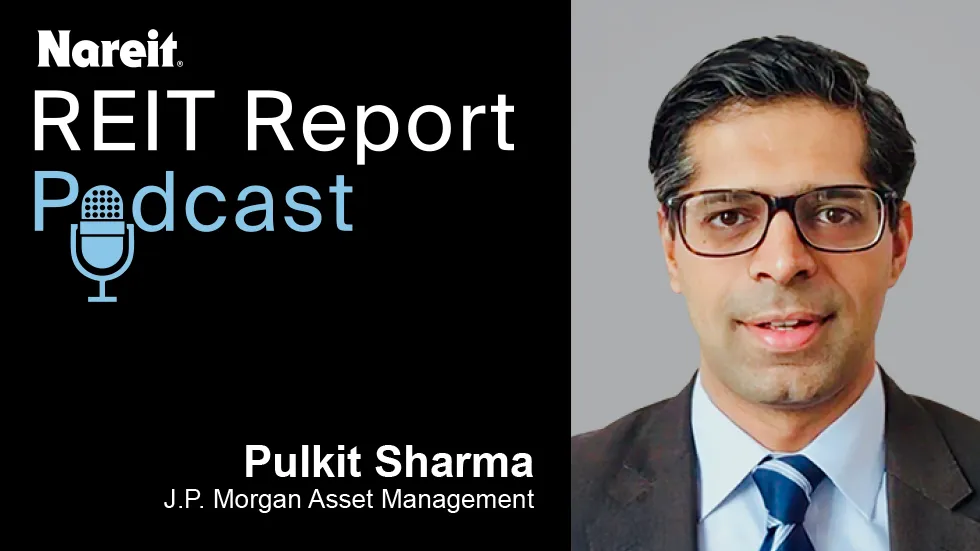
Pulkit Sharma, head of J.P. Morgan Asset Management’s Alternatives Investment Strategy and Solutions (AISS) business, joined the REIT Report podcast to review the evolving landscape of real estate investing, emphasizing the benefits of diversified portfolios that combine public and private strategies.
“When it comes to alternatives today, we believe more is better in client portfolios, broader is better, as well as active is better,” Sharma said. Real estate, and REITs in particular, play an important part of that alternative investment landscape, he added.
Sharma noted that the increased availability of data today has resulted in a more science, less art-based approach to designing outcome-oriented portfolios that target various client priorities such as income orientation, growth orientation, or a combination of both. A research piece, coauthored with GIC Singapore, shares insights into a framework for building multi-alternatives portfolios, integrating strategic sizing of positions with active marginal capital allocation to improve portfolio outcomes.
Other takeaways from the interview include:
- A REIT exposure of 20%-40%, alongside a 60%-80% allocation to private real estate, generates the highest risk-adjusted returns. “Stronger, more robust portfolios can be generated by thoughtfully combining the private and public segments of real estate.”
- REITs provide access to alternative sectors, as well as developing and emerging sectors in real estate.
- Global real estate portfolios provide increased resilience due to different timing of cycles.
- There is a role for a variety of real estate structures within diversified portfolios. “It's a matter of thoughtfully thinking about their return profile, their sector exposures, their downside risk, and their liquidity, and then sizing it appropriately to design more robust real estate asset allocations.”
Additional Resources
- A whitepaper produced by the JPMorgan Strategic Investment Advisory Group that examines the evolving landscape of real estate investing and suggests that an optimized portfolio should use both REITs and private real estate to achieve more efficient returns and better tactical flexibility:
- The AISS quarterly alternatives relative value outlook that supports investors in marginal capital allocation, capturing return dispersion, portfolio evolution and liquidity management: