Where some people see an empty building and think it should be knocked down, others—particularly developers and architects—have the imagination to recognize dozens of potential uses depending on the location, configuration, and condition of the property. In recent years, self-storage owners and operators have embraced the concept of adaptive reuse, especially in cities where building new facilities can be challenging.
“The big benefit of adaptive reuse for self-storage facilities is the cost,” says Mackay Reid, vice president of asset strategy and development for Extra Space Storage, Inc. (NYSE: EXR). “Another benefit is that new development can be limited for self-storage because of zoning. Adaptive reuse can give us an opportunity to be in more retail areas and closer to residential development, especially multifamily buildings with residents who need storage.”
Cities that are undersupplied with self-storage compared to demand, such as Chicago, New York City, Los Angeles, and St. Paul, Minnesota, are also among those with the most square feet of converted space, according to a report by StorageCafe, a division of Yardi, a provider of real estate software and data.
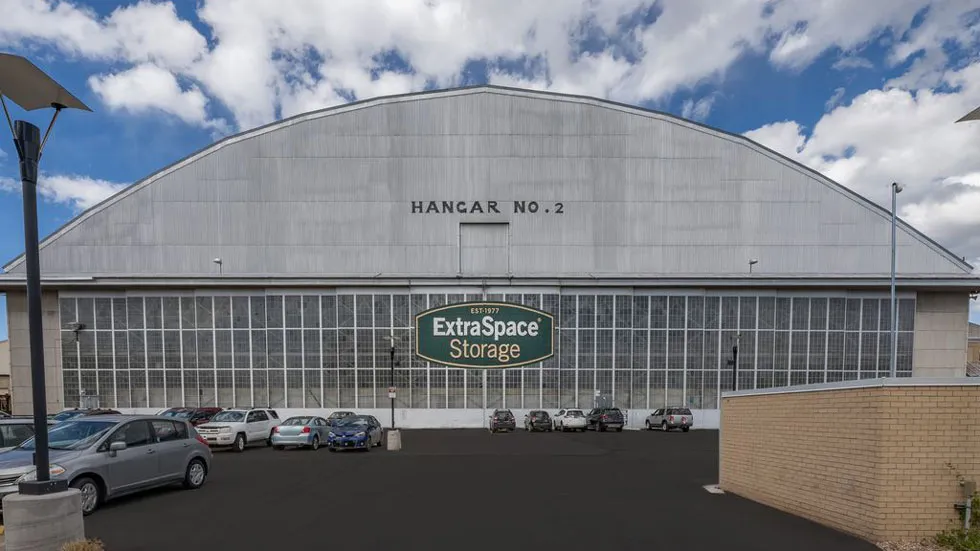
Extra Space typically buys or leases self-storage facilities, rather than developing or redeveloping them, and Reid says that many of their sites are conversions from previous uses such as large retail stores, manufacturing sites, and even an airplane hangar.
Approximately 3.8 million square feet of self-storage space is now under construction in buildings that had other functions in the past, according to the StorageCafe report, which accounts for 7.2% of all upcoming development. While Irving, Texas has more adaptive reuse self-storage space under development than any other market, the East Coast and the Midwest have the most activity. In 32 cities, every self-storage space under construction now is an adaptive reuse project.
“There’s a mosaic of variables that play into the growth of adaptive reuse in the self-storage sector,” says Doug Ressler, business intelligence manager at Yardi Matrix. “One is the distress in the office sector, but it’s also about the fact that the cost to build a new self-storage facility is more than the cost to adapt. It’s really just a dollar per square foot decision.”
Adaptive Reuse that Works
In some cities, self-storage and residential conversions fit in well with transit-oriented development goals, Ressler says.
“In many markets there are buildings available near transportation hubs that can be great for industrial and residential use,” he says. “For example, in the City of Los Angeles, a major criterion for adaptive reuse approvals is that they are near transportation.”
Ressler points out that in the Port of Long Beach, self-storage facilities are springing up in underutilized buildings to serve as interim holding areas for products delivered to the port.
“Adaptive reuse is usually cheaper than demolishing and rebuilding a building,” Ressler says. “The cost of labor is up, and the cost of money Is not likely to revert to lower rates. A construction loan starts the minute you apply, not when construction starts, so a big benefit of adaptive reuse for self-storage is that you can often get a certificate of occupancy for a few units within the building to make some income as you adapt the rest.”
Ressler estimates that adaptive reuse can reduce development costs by 37% to 50% per square foot compared to ground-up builds, according to the StorageCafe report. In addition, developers avoid land costs and permitting delays.
While retail sites may seem ideal, the StorageCafe report found that 41% of self-storage sites converted from other uses were former industrial or logistics sites, followed by 34% former offices.
“The challenge with offices is that they’re typically built to hold less than 100 pounds per square foot, and storage needs to handle loads of 125 pounds to 150 pounds per square foot,” Reid says. “In addition, you need the right loading setup. That can be a solvable problem depending on the office layout, but you really want to be able to drive trucks into a garage to deliver goods if possible.”
Another issue, Reid says, is that office redevelopers tend to want higher rents than storage typically pays. Former retail sites are just 17% of self-storage adaptive reuse projects, but they can be simpler to convert.
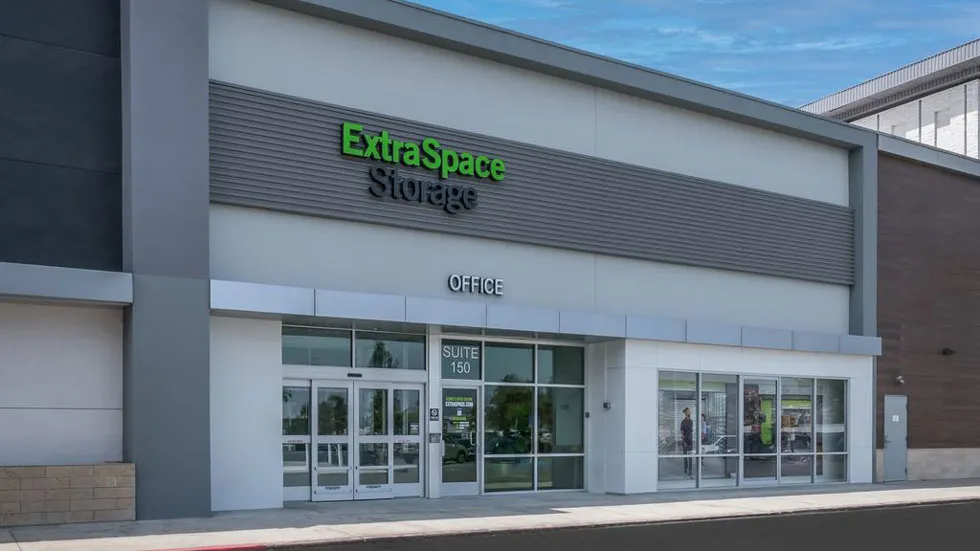
“Several years ago, a company purchased a bunch of closed Sears locations to convert them for multiple uses,” Reid says. “We did a deal for a location in El Cajon in San Diego that had an upstairs and a downstairs. We were able to put storage units in the basement level with retail sites upstairs, which worked out well.”
The ground level of that building includes an Extra Space Storage office and elevator access for customers to the lower level units.
“The key to make these facilities work is the clear height,” Reid says. “If you have a Big Box store with 40,000 square feet and we can add a mezzanine or second level, that gets us 80,000 gross square feet in the same space. But the clear height needs to be 22 feet or taller – it can be challenging if it’s less than that.”
Synergies with Shared or Adjacent Tenants
Some fundamental goals for self-storage facilities include a location with good foot traffic and proximity to residential or retail development, Reid says. Unfortunately, zoning codes often limit storage to industrial or manufacturing locations, he says.
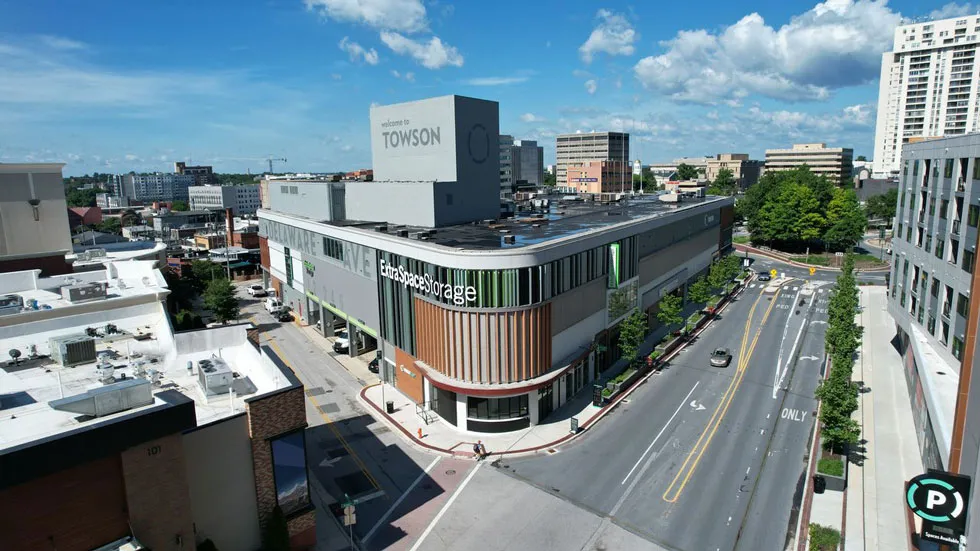
“One of the more creative spaces we have is a converted retail building in Towson, Maryland where the owners wanted to lease to retail stores,” Reid says. “In that case, it had a subgrade level and an upper level that we could use for storage units, with retail on the ground level.”
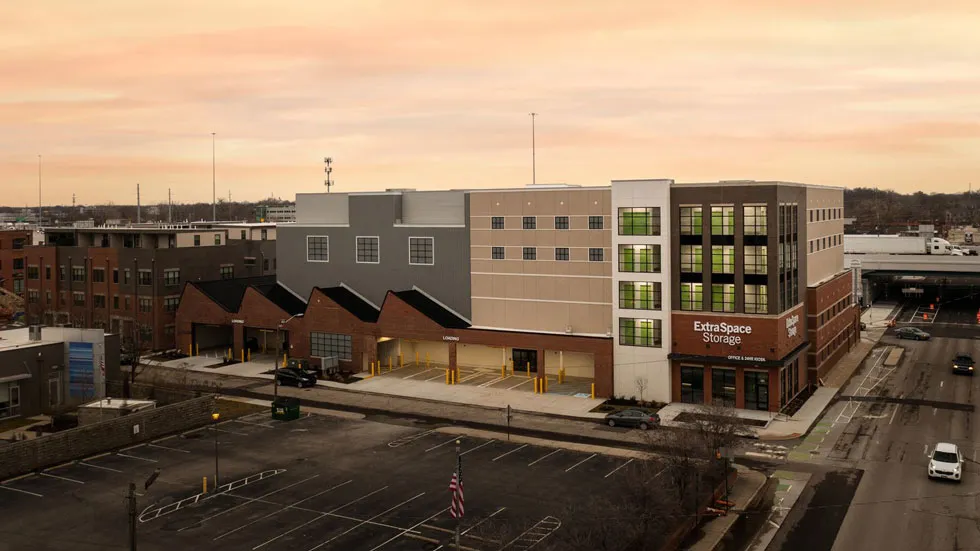
Two Extra Space Storage facilities are co-located in mixed-use developments. In downtown Indianapolis, a former hosiery factory was converted with one-half of the space devoted to housing and the other self-storage units.
“That was a 100-year old site, and storage filled a gap in the redevelopment in a neighborhood with a lot of multifamily development,” Reid says. “We love finding locations like that with complementary uses.”
A former airplane hangar in Denver was also converted to mixed-use as part of the redevelopment of the area, with restaurants, retail sites, and storage.
“Demographics have an important role in self-storage, just like in other property sectors,” Ressler says. “There’s a particularly strong correlation with housing. You typically see self-storage near apartments and grocery stores, because self-storage owners reverse-engineer their location decisions to be close to housing.”
StorageCafe’s research shows that most people want to be 1.1 mile or less from their storage facilities, especially the youngest renters who may have decent income and own furniture or other items but don’t have a large apartment yet, Ressler says.
Overcoming Challenges with Adaptive Reuse
Among the variables that make adaptive reuse easier or more difficult in various markets are zoning laws, permitting times, and NIMBYism, Ressler says.
“Cities need tax revenue, especially to make up for empty office space, so they’re more willing to readapt to accommodate other uses for buildings,” Ressler says. “They’re trying to bring in a social environment with amenities, housing, and places like grocery stores and restaurants within walking distance to make living easier. Self-storage can be part of that.”
Self-storage companies have had success in some cities by aligning their business as a support to housing, according to Reid, particularly to help solve the affordable housing issue nearly every city faces.
“Adaptive reuse is a good solution for everyone,” Reid says. “Storage facilities offer a less active use for infill sites that already have a lot of density. We don’t generate a lot of additional traffic or congestion, and we’re a complementary service for apartments.”
While many people think of self-storage facilities as large boxy industrial buildings, storage can actually fit into many different scenarios, Reid says, including adaptive reuse of unusually shaped buildings or simple multistory climate-controlled buildings in infill neighborhoods.
“The challenge of adaptive reuse in some places is the requirement for rezoning to allow self-storage,” he says. “We don’t always fit their redevelopment plan because we don’t add as many new jobs as other assets might, but we do offer a solution for housing issues in that we can support smaller units with the option of nearby storage.”
One other potential issue is the economics of storage.
“Because we need long accessible hallways and loading areas, we can’t rent 100% of the available space in our buildings as storage units,” Reid says. “We typically rent about 75% of the square footage, so that means we can’t always lease the entire space at the same rate as the former tenants, such as a Big Box store.”
Still, given the high cost of land, particularly in infill areas where self-storage is in demand, the adaptive reuse solution is one that is only likely to increase for this sector.