A recent Nareit commentary noted that fundamentals across the four traditional property types continued to show positive momentum and signs of stabilization, but occupancy rates remained mostly flat and rent growth struggled to match inflation. A closer look at CoStar data further highlights the differences in supply-demand dynamics across sectors. As of the second quarter of 2026, apartments, industrial, and retail were at or near equilibrium, while office demand outstripped supply for the fourth straight quarter.
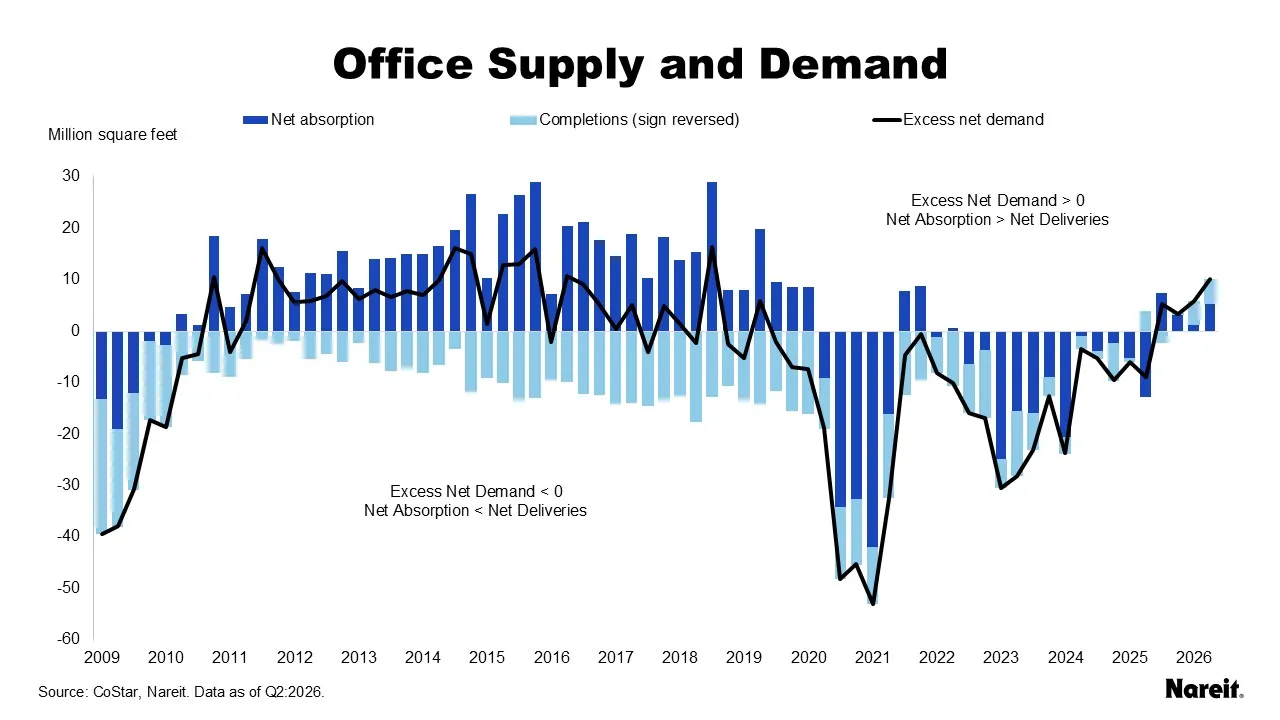
The chart above depicts quarterly office net absorption and net deliveries, as well as excess net demand from the first quarter of 2009 to the second quarter of 2026.
Office has faced a persistent supply-demand imbalance since 2019, but restrained development and stronger demand have pushed excess net demand into positive territory for four consecutive quarters. In the second quarter of 2026, occupancy stood at 86.1% and the four-quarter rental gain was 1.8%. According to Nareit’s Actively Managed Real Estate Fund Tracker, office was the only sector of the four traditional property types with an overweight relative to its index weight in the first quarter of 2026.
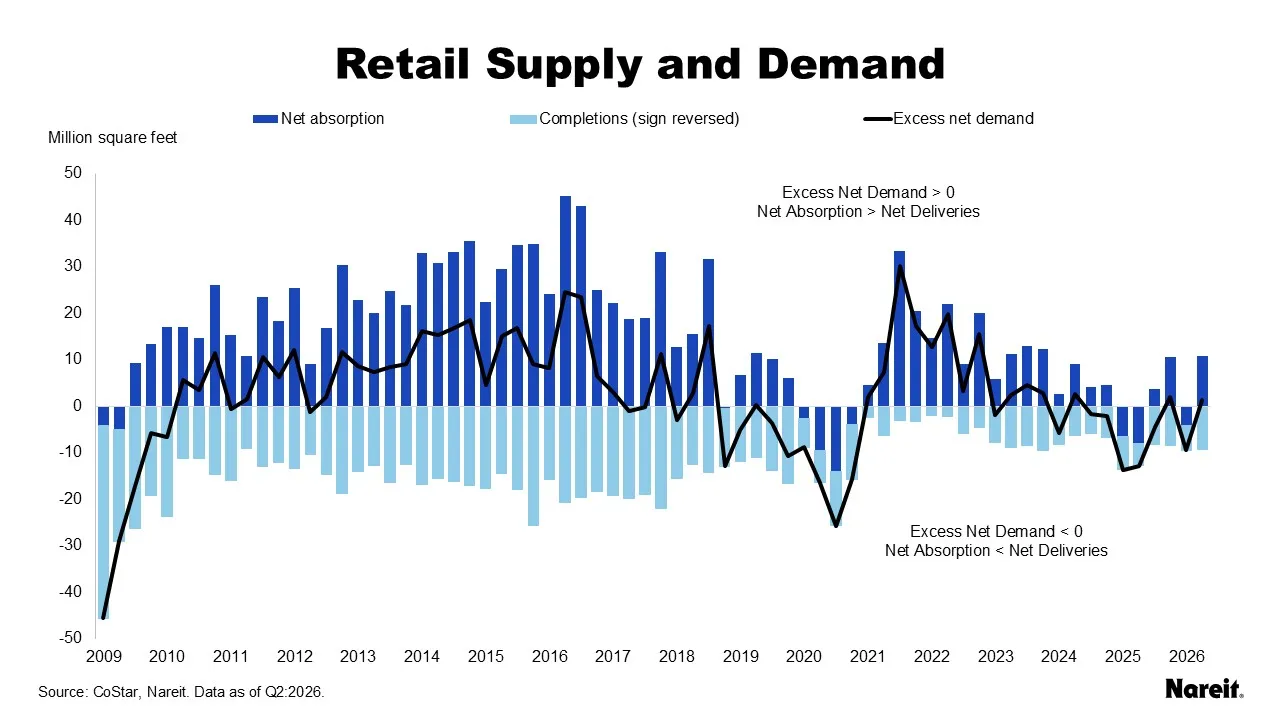
The chart above displays quarterly retail net absorption and net deliveries, as well as excess net demand from the first quarter of 2009 to the second quarter of 2026.
Retail supply and demand metrics have generally remained slightly out of balance since 2024. In the second quarter of 2026, retail occupancy and year-over-year rental growth rates were 95.6% and 2.0%, respectively. Despite ongoing demand shortfalls, both measures were the strongest among the four traditional property types.
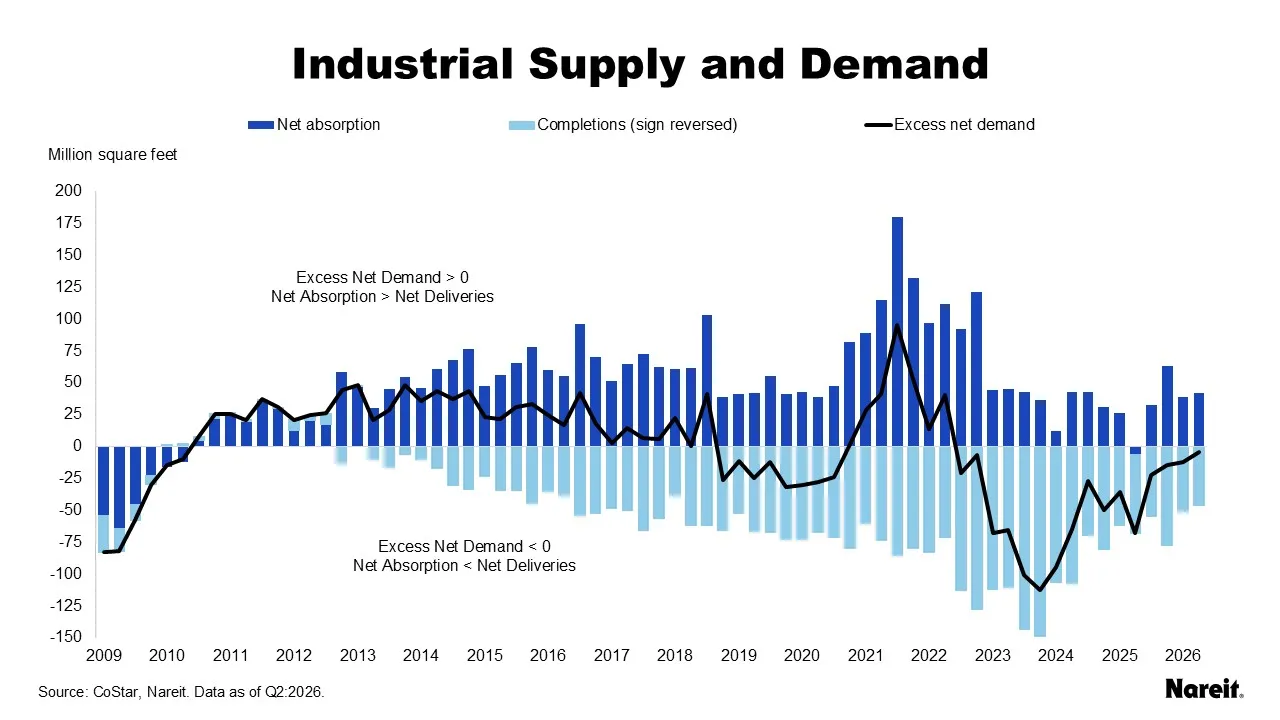
The chart above shows quarterly industrial net absorption and net deliveries, as well as excess net demand from the first quarter of 2009 to the second quarter of 2026.
Industrial excess net demand has been negative for 16 straight quarters. After starting its decline in mid-2022 and reaching its nadir at the end of 2023, it moved close to supply and demand balance (i.e., approached zero) by mid-2026. In the second quarter of 2026, industrial occupancy was 92.5% and year-over-year rent growth was 1.5%.
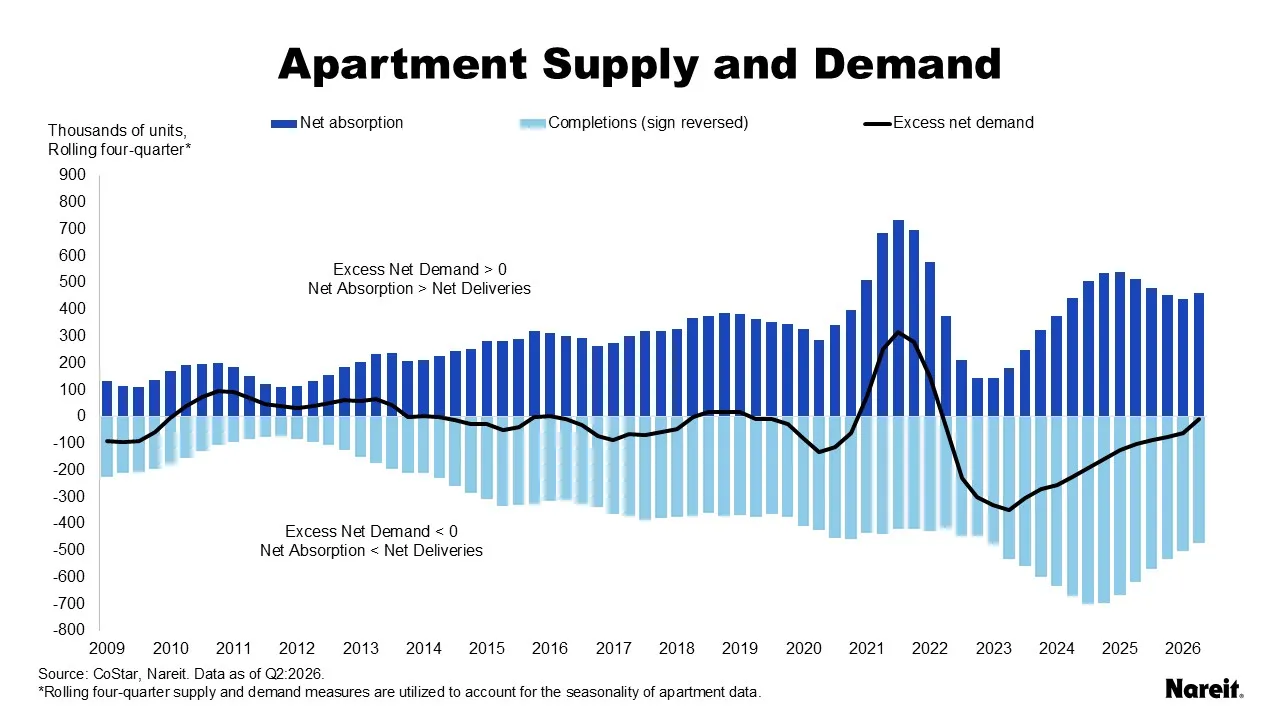
The chart above presents quarterly apartment net absorption and net deliveries, as well as excess net demand from the first quarter of 2009 to the second quarter of 2026.
Apartment supply has exceeded demand for more than four years, but the sector is now approaching equilibrium. The prolonged imbalance has weighed on occupancy and rent growth rates. As of the second quarter of 2026, occupancy averaged 91.9%, remaining near its lowest level since 2000, and rent growth struggled to remain positive at 0.8%.
Commercial real estate fundamentals continue to improve. As of the second quarter of 2026, apartments, industrial, and retail were at or near equilibrium and office demand had outpaced supply for a year. Looking ahead, operational performance will depend on each sector’s ability to further strengthen its supply-demand dynamics.