Financial markets have remained volatile as investors react to periods of relative peace in the Middle East, followed by episodes of outright conflict, as a permanent solution to the crisis remains elusive. Given the continued cycles of conflict and peace in the region, it’s useful to re-examine the periods of performance that have defined the 2026 returns landscape for global real estate, along with the broader stock market.
As of July 27, the FTSE EPRA Nareit Developed Extended Index has gained 13.0% year-to-date. North America has led global real estate higher, returning 22.9% in 2026 while Developed Europe has gained 2.9%, and Developed Asia is down slightly with a total return of -1.5%.
Broader market equities rebounded from the crisis as well, but on a year-to-date basis real estate continues to outperform. The FTSE All World has returned 10.2% year-to-date. Benchmark yields have climbed over the course of the year as the yield on the U.S. 10-year Treasury climbed from 3.96% at the beginning of hostilities to 4.65% as of July 27.
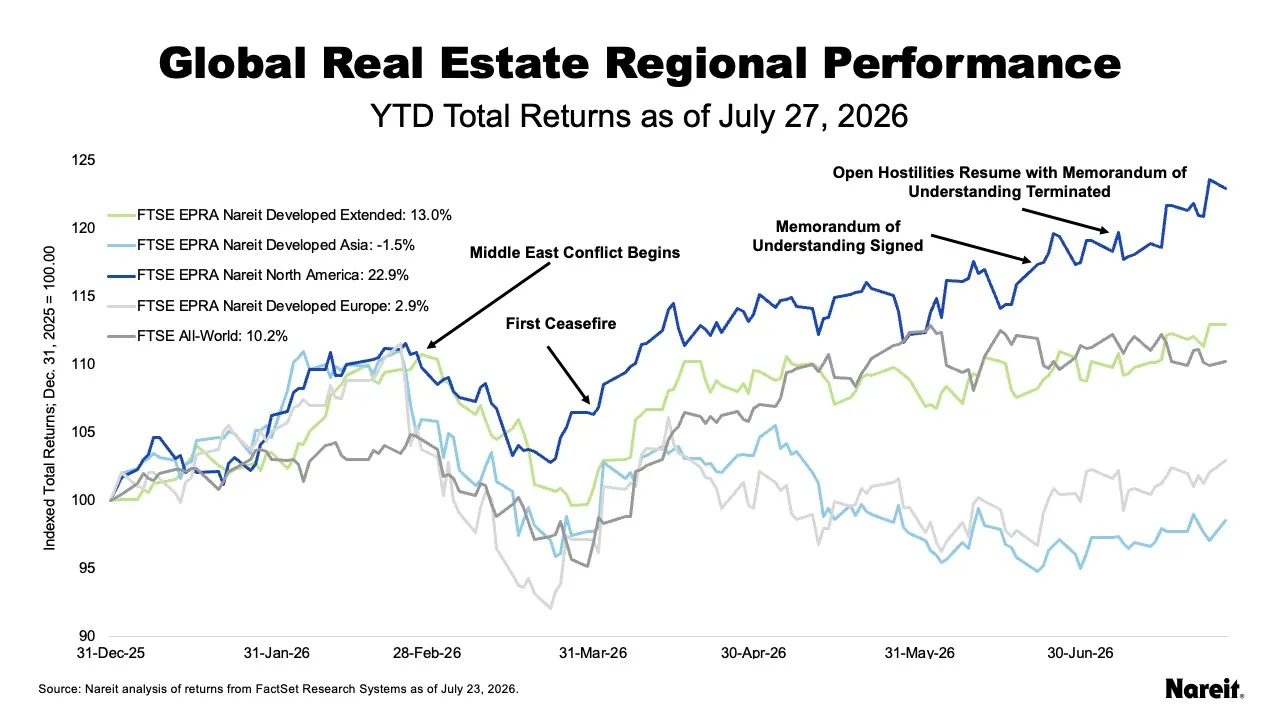
As reflected in the chart above, North American real estate has been resilient in the face of geopolitical turmoil while Asia and Europe have struggled to regain their pre-conflict performance. Through July, global real estate performance in 2026 was defined by three distinct phases: a strong start to the year through February, a sharp correction due to the conflict with Iran in March, and a broad recovery in April. With the termination of the Memorandum of Understanding between the U.S. and Iran in early July and the ensuing volatility in energy prices, investors will be monitoring the situation to see if the resumption of hostilities sparks a new downward correction.
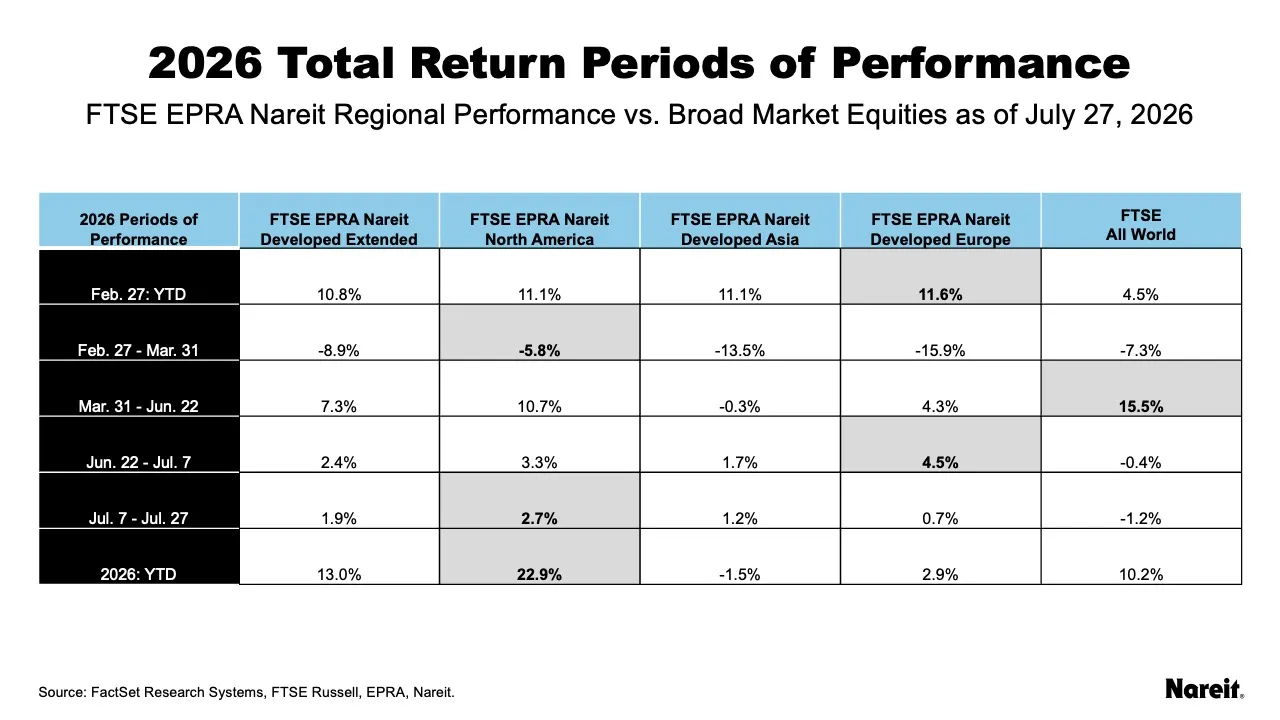
As reflected in the table above, all regions of the FTSE EPRA Nareit Global Real Estate Index Series began 2026 posting double digit returns through Feb. 27, led by Developed Europe at 11.6%, with North America and Developed Asia both returning 11.1%. Global equities significantly underperformed global real estate as the FTSE All World posted a total return of 4.5%.
With the outbreak of conflict with Iran at the end of February, both real estate and equities suffered significant corrections. North America weathered the storm the best as of the first ceasefire at the end of March, with a decline of 5.8% from the beginning of the conflict. Developed Asia and Developed Europe had more significant setbacks, with returns of -13.5% and -15.9%, respectively. Global equities underperformed North American real estate, declining 7.3%.
The period from the first ceasefire to the signing of the Memorandum of Understanding between the United States and Iran on June 22 resulted in disparate performance between real estate and equities, as well as between regions within the FTSE EPRA Nareit series. The FTSE All World led over this period, returning 15.5%. North American and European real estate bounced back with respective returns of 10.7% and 4.3%, while Asia was flat with a return of -0.3%.
While the Memorandum of Understanding was in effect from June 22 – July 7, global real estate outperformed, led by Developed Europe gaining 4.5%, North America rising 3.3%, and Developed Asia returning 1.7%. Global equities posted a narrow decline of 0.4%.
After the abandonment of the Memorandum of Understanding, real estate continued to outperform, led by North America’s 2.7% return from July 7 – July 27. Developed Asia and Developed Europe followed with respective returns of 1.2% and 0.7%. Global equities continued to underperform, losing 1.2%.
Year-to-date as of July 27, global real estate continues to outperform with the Developed Extended index returning 13.0%, led by North America’s 22.9% return. Developed Europe and Developed Asia have not been able to regain the performance they began the year with, posting respective returns of 2.9% and -1.5%. Global equities have underperformed global real estate, returning 10.2%.
Because of the disparate performance between asset classes as well as between real estate regionally, and the innate unpredictability of the conflict, it will be important to monitor these inflection points as they manifest.