A recent Nareit commentary noted that the public-private real estate valuation gap persists, with private appraised property values still disconnected from market realities. In this environment, it appears that the “ostrich effect”—investor behavior where risky situations are avoided by pretending that they do not exist—continues to aptly describe the valuation practices of many private real estate investment managers and appraisers. Sector-level comparisons of public and private cap rates further highlight the divide between market and appraisal-based valuations.
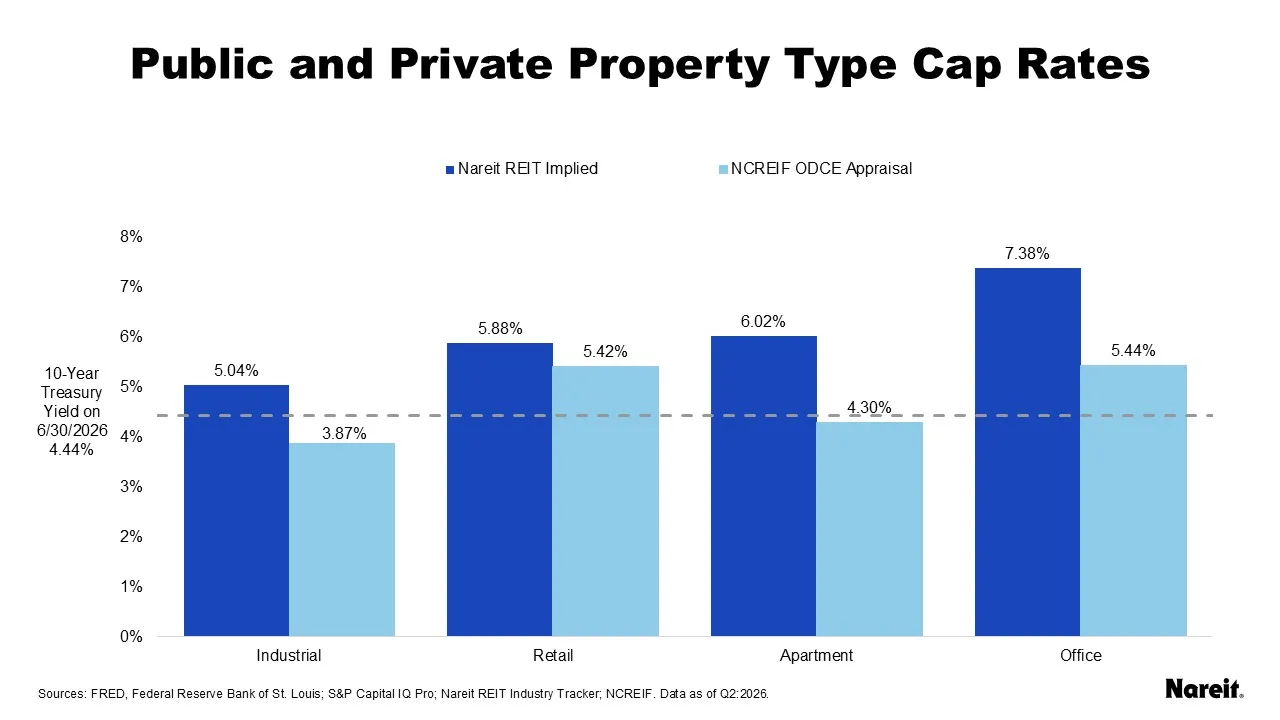
The chart above displays second quarter of 2026 REIT implied and private real estate appraisal cap rates for the four traditional property types using data from Nareit’s REIT Industry Tracker and National Council of Real Estate Investment Fiduciaries (NCREIF) open end diversified core equity (ODCE) funds. It also shows the quarter-end U.S. 10-year Treasury yield.
Sector-specific differences between REIT implied and appraisal cap rates capture the varying disparities found in market and appraisal-based real estate valuations. Of the four property types, office had the largest differential at 194 basis points (bps). The differences for apartments, industrial, and retail were 172, 117, and 46 bps, respectively.
The observed property type cap rate spreads vary widely and point to serious disparities between market and appraisal-based property valuations. Recognizing that significant rises in appraisal cap rates are warranted, further material write-downs are likely on the horizon for the private real estate market. All else equal, adjusting the private appraisal cap rates to REIT implied cap rates would require private value write-downs of more than 25% for office and apartments, more than 20% for industrial, and less than 10% for retail.
Taking a closer look at the industrial and apartment sectors, it seems that private real estate investment managers and appraisers may be wearing blinders when it comes to the broader investment landscape. For years, the industrial and apartment appraisal cap rates have been lower than and akin to the 10-year Treasury yield, respectively. Appraisal cap rates at or below the risk-free rate are difficult to justify, especially for prolonged periods of time, as they simply fail to reflect current capital market conditions.
It appears that the ostrich effect continues to persist in private real estate valuations. For some market participants, ignorance may be bliss, but capital market realities cannot be ignored forever. With this in mind, write-downs are likely forthcoming for many ODCE properties, but the timing of these adjustments remains uncertain. While these potential declines may weigh on private real estate’s appeal, they would enhance the relative attractiveness of REITs, whose pricing more accurately reflects current economic and financial market conditions.