In today’s economy, elevated and potentially rising interest rates worry real estate investors. Elevated or rising interest rates, however, do not necessarily equate to weak, or poor, real estate performance.
- Focusing on interest rate levels, a recent Nareit commentary found that real estate, on average, has performed well in different interest rate environments with REITs besting private real estate performance in each cohort.
- When it comes to interest rate changes, historical data shows that REITs have generally enjoyed positive total returns in both rising and falling interest rate environments with the economic backdrop playing a critically important role.
- Over rolling four quarters since 1992, REITs posted positive total returns in 77.4% and 78.7% of rising and declining interest rate periods, respectively.
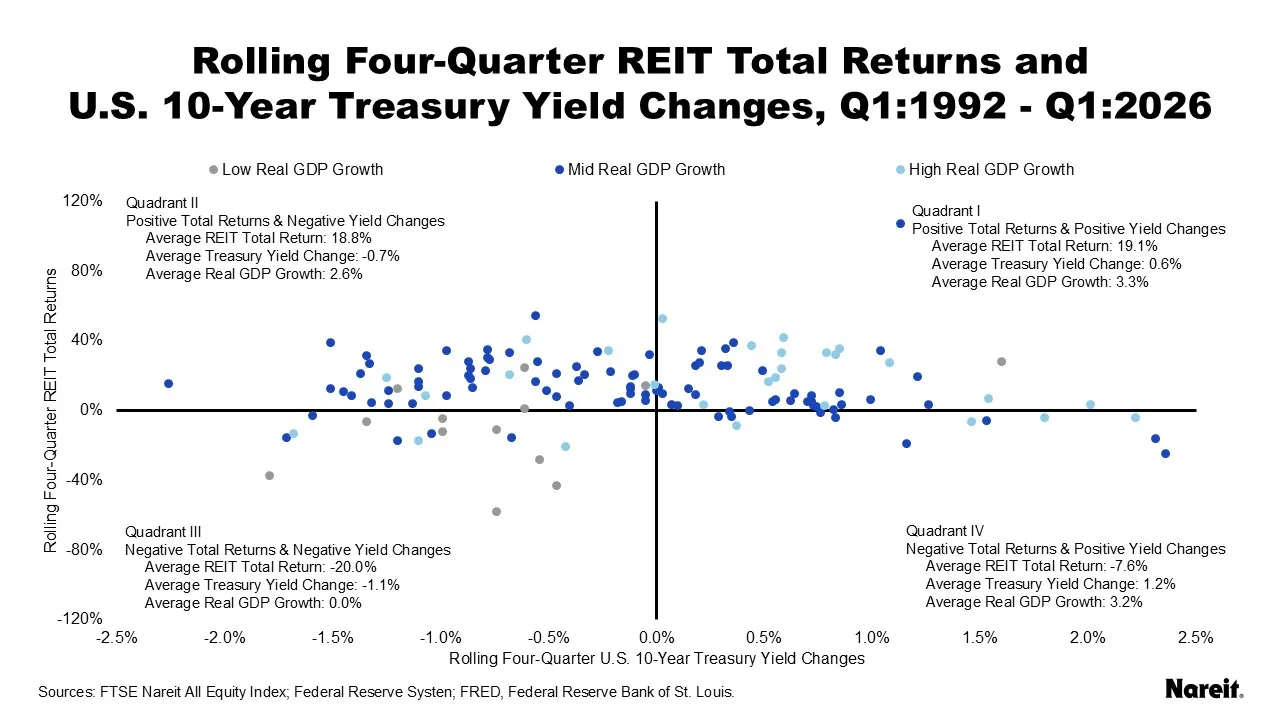
The chart above is divided into quadrants and displays a scatter plot of four-quarter changes in the 10-year Treasury yield and four-quarter total returns for the FTSE Nareit All Equity REITs Index using data from the first quarter of 1992 to the first quarter of 2026. Data points were color-coded to reflect four-quarter real GDP growth rates. The economic growth rate threshold for the low group was set at 1%; it was 4% for the high group. The low, mid, and high real GDP growth groups were shaded gray, bright blue, and light blue, respectively.
Quadrants I (positive total returns and positive yield changes) and IV (negative total returns and positive yield changes) include 62 periods that experienced a rise in the U.S. Treasury yield. A tally of the observations in Quadrant I shows that REITs posted positive total returns in 77.4% of the rising interest rate periods. The average four-quarter REIT total return for Quadrant I was 19.1%, the highest among the quadrants. Return performance for Quadrant IV averaged -7.6%. Economic growth was typically healthy during the rising yield periods. Average four-quarter real GDP growth rates were 3.3% and 3.2% for Quadrants I and IV, respectively, and only one period of low real GDP growth was observed.
Quadrants II (positive total returns and negative yield changes) and III (negative total returns and negative yield changes) include 75 periods that experienced a decline in the U.S. Treasury yield. A tally of the observations in Quadrant II shows that REITs posted positive total returns in 78.7% of declining yield periods. The average four-quarter REIT total return for Quadrant II was 18.8%. In contrast, Quadrant III performance averaged -20.0%. Twelve of the 13 low real GDP growth periods were observed in the falling yield periods; 66.7% of these were in Quadrant III. Average four-quarter real GDP growth in Quadrant II was 2.6%; it was 0.0% for Quadrant III. It appears that falling yields and weak economies have often been a recipe for poor REIT returns.
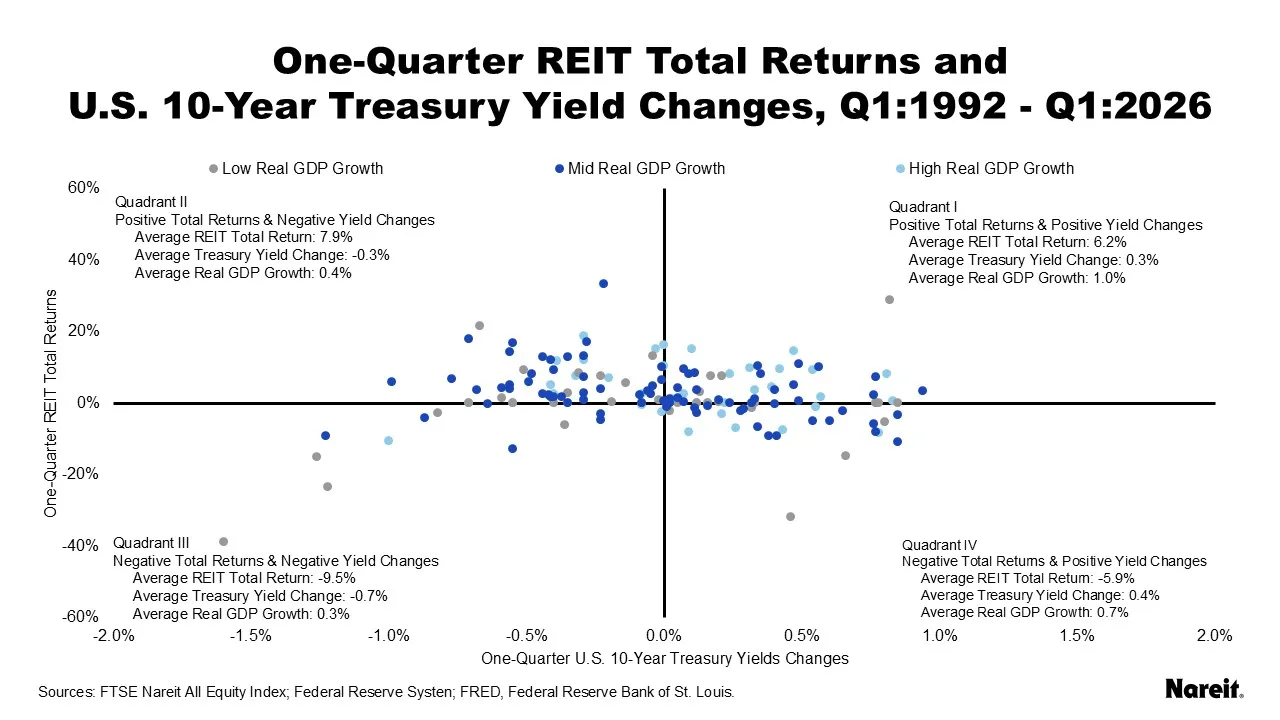
The chart above acts as a check on the robustness of the initial results. It displays a scatter plot of one-quarter 10-year Treasury yield changes and four-quarter FTSE Nareit All Equity REITs Index total returns. Data points are similarly color-coded, but reflect one-quarter real GDP growth rates. Thresholds for the low and high groups were 0.25% and 1.00%, respectively.
A comparison of the four-quarter and one-quarter analyses shows that the results were similar.
- REITs continued to post positive total returns in the majority of rising and falling U.S. 10-year Treasury yield periods. For the one-quarter analysis, REITs posted positive total returns in 60.6% and 78.8% of the rising and falling interest rate periods, respectively.
- Real GDP growth, on average, continued to be stronger in rising interest rate periods. One-quarter real GDP growth rates averaged 1.0% and 0.7% for Quadrants I and IV, respectively. They were 0.4% for Quadrant II and 0.3% for Quadrant III.
- The majority of the low real GDP growth periods continued to be observed in falling yield periods, Quadrants II and III. In the one-quarter analysis, 15 of the 25 low real GDP growth periods were observed in the falling interest rate periods.
- Falling yields and weak economies continued to be a recipe for poor REIT returns. Once again, Quadrant III had the weakest economic and REIT performances. The one-quarter real GDP growth rate and REIT total return averaged 0.3% and -9.5%, respectively.
While changing interest rates may worry some property investors, historical data show that REITs have performed well during periods of both rising and falling long-term interest rates. Economic conditions have also played an important role in REIT investment performance.
While the current strength of the U.S. economy may provide some comfort for real estate investors, REITs possess several factors that make them particularly well positioned to face a changing (and rising) interest rate environment. These include best-in-class operational expertise, disciplined and well-structured balance sheets, improving valuation dynamics, and efficient and ready access to a variety of cost-advantaged capital sources.