Nareit’s REITworld: 2025 Annual Conference convened 1,000 REIT leaders and industry professionals Dec. 8–11 in Dallas. Nareit wishes to extend its appreciation to the event’s 20 sponsors, including Platinum Sponsors Alston & Bird, Ferguson Partners, and Yardi.
At REITworld, Nareit announced its Industry Leadership and Achievement Awards, two individual awards presented annually. Thomas Baltimore, CEO of Park Hotels & Resorts, was honored with the Industry Leadership Award; and William Ferguson, CEO of Ferguson Partners, was honored with the Industry Achievement Award. Nareit also announced 20 years of its Leader in the Light® recognition initiative at REITworld.
Continue reading for a recap of the general and concurrent session presentations at this year’s event.
Lunch General Session: Capital Markets and REIT Outlook

Sumit Roy, president and CEO of Realty Income Corp. (NYSE: O), and Nareit 2026 Chair, moderated the lunch general session on the first day of REITworld 2025, which discussed the outlook for REITs and capital markets. Panelists included Kevin McClure, managing director at Wells Fargo Securities, Gina Szymanski, managing director and CIO at AEW Capital Management, and David Toledano, managing director at Mizuho Securities USA LLC.
The discussion focused on the outlook for REITs in 2026, highlighting both macroeconomic drivers and sector-specific opportunities. On the macro side, potential interest rate cuts and ongoing inflation/labor market dynamics are expected to influence capital markets, with fundamentals, and credit conditions creating a constructive environment for REIT performance.
Despite uncertainty, equity and debt issuance and alternative sources of equity, such as REITs creating perpetual open-ended funds and private capital, are expected to support growth and liquidity, panelists said. M&A activity may pick up, driven by arbitrage opportunities, activist involvement, and public-to-private valuation gaps.
Across sub-sectors, net lease and specialty retail are expected to generate solid growth, with strong cash flows, and opportunities for FFO growth through asset recycling. Traditional industrial properties will benefit from e-commerce tailwinds but face volatility from supply issues and occupancy sensitivity, while cold storage is viewed as a late-cycle contrarian play with durable top-line growth and elevated yields. Data centers show multi-year growth potential, low vacancy, and high pre-leased development.
Health care and senior housing continue to benefit from secular tailwinds and improved occupancy, with REITs positioned for stable returns. Multifamily faces short-term demand softening due to demographic and seasonal factors, but U.S. valuations remain attractive relative to private-market comparables.
Overall, the outlook for REITs in 2026 is cautiously optimistic, according to panelists, with strong fundamentals, structural tailwinds, and selective opportunities for growth and yield enhancement, tempered by valuation and macroeconomic uncertainties.
Lunch General Session: AI—Redefining the Future of Real Estate
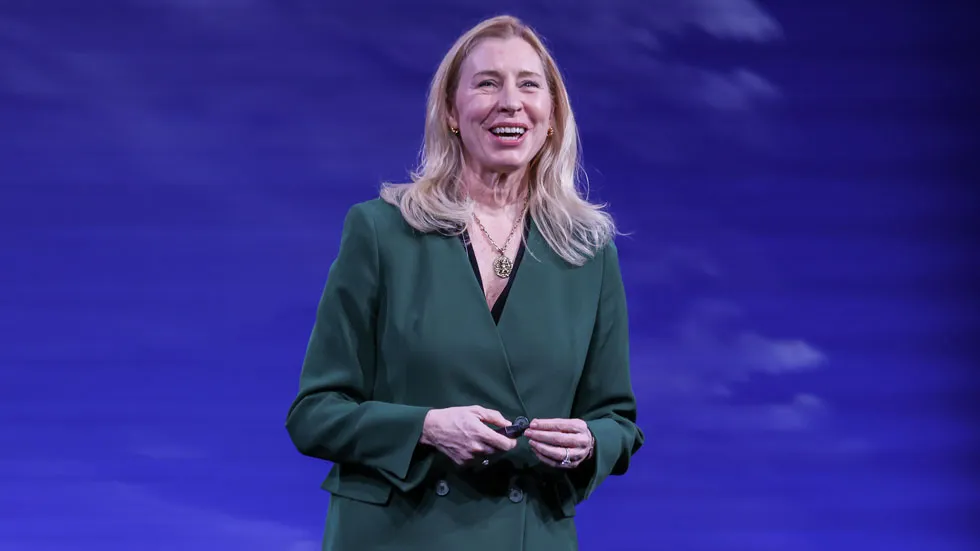
Artificial intelligence is reshaping the global economy, but its long-term impact will depend on how policymakers, investors, and businesses navigate a complex mix of growth, inflation, and political risk, according to Rebecca Patterson, chief investment strategist at Vanguard. Patterson delivered the keynote address at REITworld’s Lunch General Session, AI—Redefining the Future of Real Estate.
Patterson described a U.S. economy that continues to grow at a resilient pace of roughly 2%, even as underlying vulnerabilities begin to surface. While AI investment is driving capital spending and innovation, it is also creating new pressures. “Companies feel compelled to invest in AI to stay competitive,” Patterson said, “but they’re being told to keep overall budgets flat.” As a result, firms are increasingly looking for cost savings, which could slow hiring and weigh on job growth in 2026, even without a traditional recession.
She also highlighted affordability as a growing political flashpoint. Rising electricity costs, housing prices, and infrastructure constraints are increasingly being linked, fairly or not, to AI-driven demand. “When affordability becomes a problem, someone is going to be blamed,” Patterson said, noting that technology companies could become a convenient target as election cycles approach.
Monetary policy will remain a key driver for markets and real estate. With inflation proving stubborn and labor market conditions gradually cooling, the Federal Reserve faces a difficult trade-off. “Cut too little and you risk damaging the labor market,” Patterson said. “Cut too much, and you risk reigniting inflation and losing credibility.” She also pointed to large federal budget deficits as a structural force that could keep long-term interest rates elevated, impacting mortgage rates, corporate borrowing, and real estate valuations.
Despite the uncertainty, Patterson offered reasons for cautious optimism. Investor sentiment toward real estate is improving, with surveys showing a strong majority planning to increase allocations over the next 12 to 18 months. As valuations in AI-related sectors rise, she said, many investors are looking for diversification and inflation protection. “Real estate is increasingly viewed as a place to find both,” Patterson said.
Economic Outlook: REIT & CRE Market Performance

In this session, panelists discussed how inflation, the current interest rate environment, and trade policy uncertainty have affected REITs. They highlighted how REITs have maintained strong operational performance and balance sheets, and why now is an attractive entry point for investors, particularly given that REITs are trading at a discount to broader equities and private real estate. John Worth, EVP of research and investor outreach at Nareit, moderated the panel, which also featured: Nicole Funari, VP of research at Nareit; Mariya Letdin, Kyle Riva associate professor of real estate at Florida State University; and Edward F. Pierzak, SVP of research at Nareit.
Navigating the Washington Landscape: What’s Next for REITs?

During this panel, speakers discussed legislative and regulatory developments affecting REITs and the commercial real estate industry in 2025 and 2026. Cathy Barre, EVP of policy and public affairs and general counsel at Nareit, moderated the panel, which featured additional Nareit staff: Cameron Arterton, deputy EVP for policy and public affairs; John Jones, SVP of government relations; Steven Lowery, VP of policy and public affairs; and Robert Dibblee, SVP of government relations.
AI, Machine Learning, and the Future of Proptech in Real Estate

John Jones, Nareit’s SVP for government relations, moderated a panel discussion on the first day of REITworld 2025 that looked at AI, machine learning, and the future of proptech in real estate. Jones was joined by Duke Long, founder of The Duke Long Agency, and Amy Polvado, chairwoman of the U.S. Proptech Council.
Jones opened the discussion by noting that AI has gone beyond the realm of experimentation and has moved into the mainstream, with more than half of public companies now mentioning AI in their SEC filings.
Turning to REITs, he pointed out that the breadth of the industry gives it a unique vantage point to see how technologies like AI are transforming the built environment and driving innovation across the entire economy.
Jones asked the panel about the biggest barriers to AI and proptech adoption in the REIT industry, and whether they are structural or behavioral. Polvado responded that both barriers exist, adding that “there is an infrastructure problem. The data center sector is trying to solve that problem.” Long agreed, noting that while multiple restraints do exist, AI has become “foundational technology.”
Meanwhile, how REIT leaders should think about unlocking the full value of the data within their ecosystems—from tenant operations to building performance to capital markets—was another question the panel addressed. Polvado and Long stressed the importance of spending time on data governance and noted that new companies have emerged that focus solely on extracting data and helping guide REITs as to how best to use that data.
Other questions looked at whether REITs are actively building in-house data science and AI capabilities. Polvado pointed out that not many REITs at this time have chief intelligence officers on staff.
The panel also discussed: the impact AI, machine learning, and automation could have on real estate labor, workforce development, and talent needs over the next five to 10 years; how soon robotics could meaningfully reshape construction; and whether we are approaching a moment where buildings are designed, permitted, and built largely by robots.
The New Playbook for Asset Allocation: Insights on Real Estate and REITs

In this session, panelists focused on how asset allocation providers are integrating REITs into some of the fastest growing investment offerings within the pension and retirement markets, including target date funds and managed accounts. They also spoke about a recent study from NMG Consulting about the role of REITs in investment portfolios. Some of the report’s key themes focused on the benefits of REITs and emerging industry trends. Kurt Walten, SVP of investment affairs at Nareit, moderated the panel, which also featured: Joshua Dietch, a partner at NMG Consulting, and Andy Rubin, an institutional portfolio management team lead for high income and alternative strategies at Fidelity Investments.
Leveraging REITs to Drive Long-Term Sustainability and Social Value

In a wide-ranging session on sustainability and social value, Nareit leaders underscored how people, partnerships, and long-term risk management are shaping the future of the REIT industry.
Opening the discussion, Ayris Scales, Nareit’s SVP of social responsibility and global initiatives, urged attendees to think beyond a narrow lens when considering social responsibility. She emphasized workforce culture, community partnerships, and leadership alignment as business imperatives, not side initiatives. “None of our businesses can be sustainable if we’re not taking care of our people,” Scales said, pointing to the importance of retention, mid-career development, and values-driven cultures.
Scales also highlighted Nareit’s Dividends Through Diversity initiative, which has raised nearly $3 million and invested close to $2 million in workforce pathways, small business growth, and community prosperity. “We’re not giving just to give,” she noted. “We’re creating long-term assets aligned with our long-term vision for the industry.”
Jessica Long, Nareit's SVP of environmental stewardship and sustainability, traced the evolution of sustainability in commercial real estate from early voluntary energy-efficiency efforts to today’s investor-driven expectations around climate risk, transparency, and performance. She described how Nareit’s Real Estate Sustainability Council, now 132 leaders across 80 member groups, is focused on real estate-specific metrics, reducing reporting burdens, and helping members navigate emerging regulatory requirements in the U.S. and abroad.
The session also previewed expanded sustainability and human-capital content at REITwise and highlighted findings from Nareit’s Sustainability Report, reinforcing that sustainability and social responsibility are now core drivers of long-term value creation for REITs and their stakeholders.