In its Real Estate Trends 2026, S&P Global used its proprietary With Intelligence data through midyear to identify several private property market trends, including:
- Fundraising and fund launch targets are facing challenges and remain subdued.
- Investors are shifting toward non-core strategies, where alternative property sectors play a larger role.
- Redemption queues remain problematic for some core funds.
Public equity REITs can offer viable, and potentially preferred, solutions to the challenges each of these trends present.
Private Real Estate Fundraising and Fund Launch Targets Stumble
S&P Global’s With Intelligence data show that private real estate fundraising reached $81.7 billion in the first half of 2026; the third-lowest six-month level in a decade. Real estate fund launch targets also stumbled, reaching their lowest level ($74.3 billion) since 2017. In both cases, capital was concentrated among the largest funds.
As private real estate investors seek larger managers with proven track records, they may also want to consider equity listed REITs, which typically offer sector specialization, scale, best-in-class operating expertise, and access to well-located, high-quality, institutional-grade properties. Today, REITs have also generally maintained solid operations, disciplined balance sheets, cost-of-capital advantages, and attractive valuations relative to private real estate. For those investors who prefer fund structures, REITs have increasingly offered these vehicles.
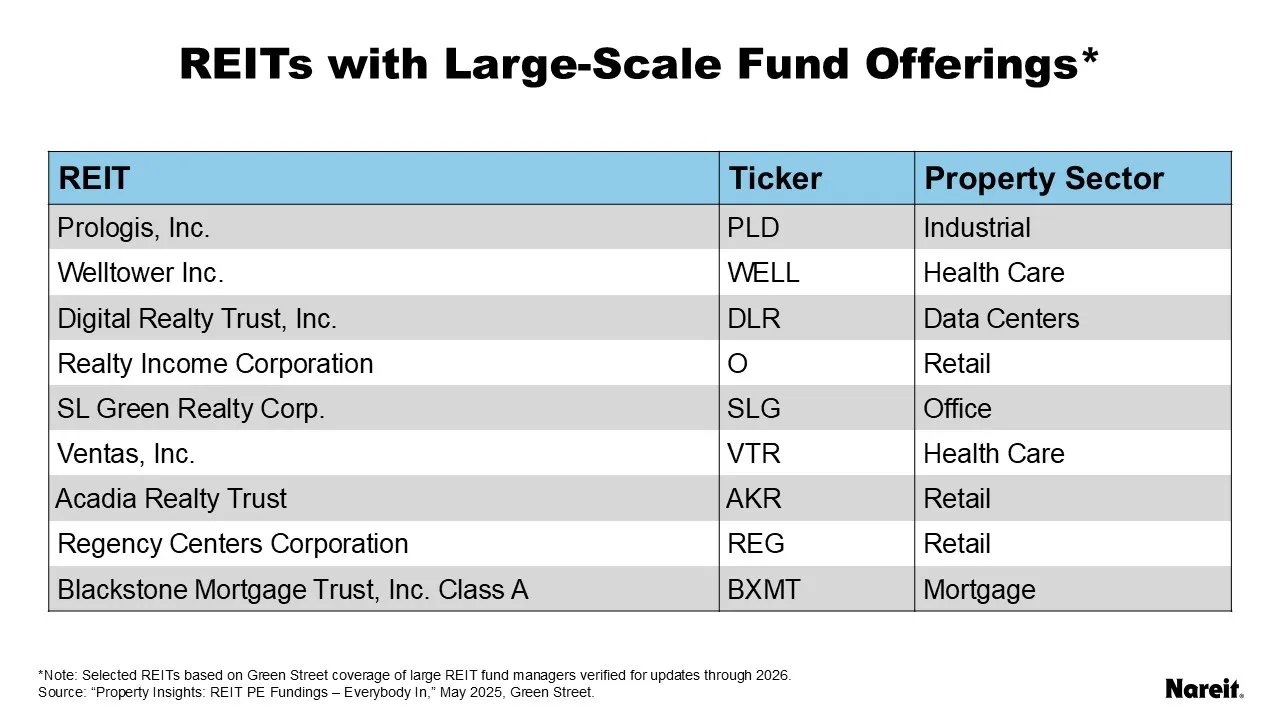
The table above highlights a sample list of REITs that have expanded into the investment management business and offer fund vehicles of significant scale. While Prologis, Inc. (NYSE: PLD) has historically been the dominant player in this space, new(er) entrants are offering equity and debt investments across a range of property sectors including health care, data centers, triple net leases, and office. In addition to funds, many REITs participate in joint venture structures with institutional investors, e.g. the greater than $15 billion data center joint venture between Equinix, Inc. (Nasdaq: EQIX) GIC, and CPPIB.
Shifting to Non-Core (& Alternative Sector) Strategies
According to S&P Global, investor intentions have continued to focus on non-core strategies, where non-traditional property sectors are common. REITs can give investors an efficient way to access alternative sectors. By embracing innovation and adapting to the changing commercial real estate landscape, U.S. public equity REITs are at the forefront of owning and operating real estate that houses the modern economy. They currently offer 13 total equity and 11 “pure play” property sectors.
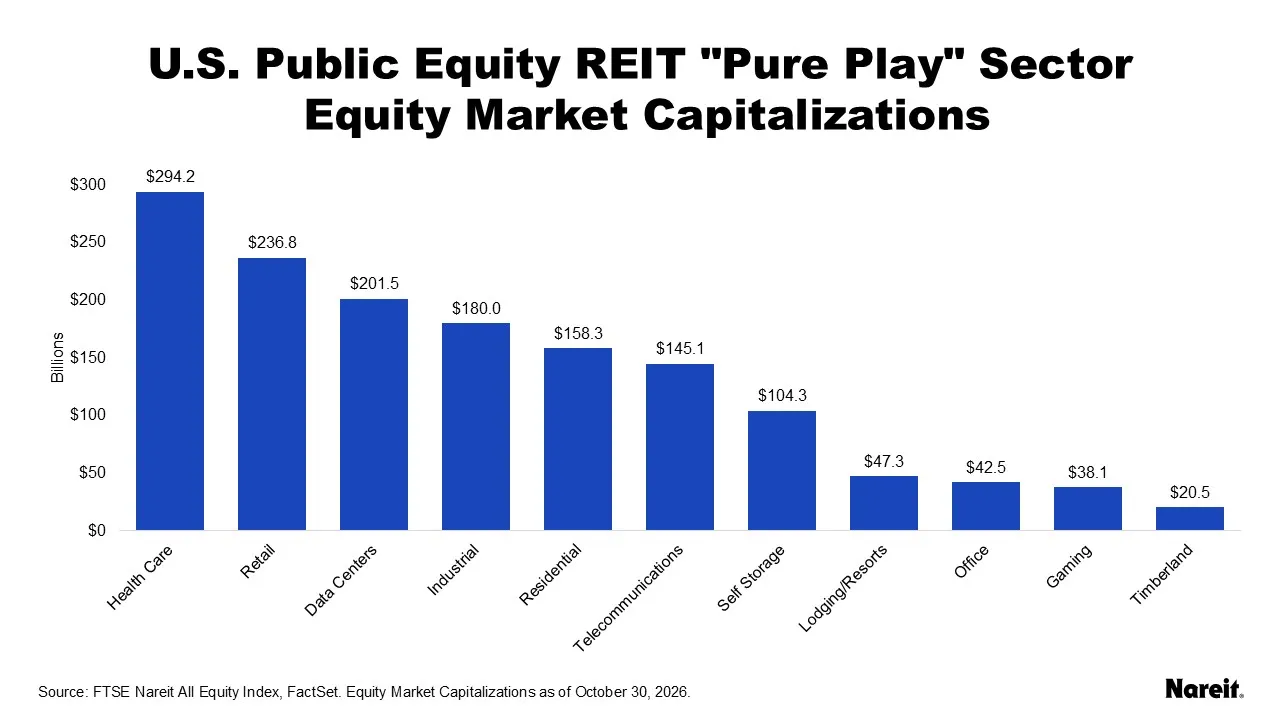
The chart above displays the equity market capitalizations of the 11 “pure play” sectors in the FTSE Nareit All Equity Index as of the end of October. Ongoing REIT sector innovation has benefited property investors by offering an expansive menu of investment choices and opportunities with broad investor appeal.
Minding the Core Fund Redemption Queues
With Intelligence data also indicated that sizable redemption queues have persisted at some core open end real estate funds. Along with the recent public-private real estate valuation divergence, these queues have lingered because appraisers and portfolio managers have been reluctant to properly mark their property assets to market. They underscore the challenges that these funds face in honoring their liquidity promises when investors want or need their capital most. Significant investor frustration could be avoided by investing in listed equity REITs.
While private core open end real estate funds have kept a narrow, less evolved focus on traditional property types, REITs offer a broad menu of investment options spanning both traditional and non-traditional (i.e., new and emerging) sectors. In executing a core investment strategy, listed equity REITs can deliver greater efficiency, transparency, diversification, flexibility, liquidity, and performance than private core funds, along with significantly lower investment management fees.
REITs Provide Solutions
Recent private real estate market trends may present challenges for investors, but listed equity REITs can offer efficient, and potentially preferable, solutions to these problems. REITs provide cost-effective ways to enhance diversification, “complete” private real estate portfolios, and execute strategic and tactical investments.
Looking forward, REITs are well positioned to:
- Expand their presence in fund management,
- Become the natural choice for accessing modern economy property sectors, and
- Provide a better way to execute a core real estate investment strategy.