Selecting the next CEO is one of a REIT board’s most important responsibilities, but identifying the right leader requires looking beyond financial expertise and industry experience. As the REIT investor base evolves and expectations for corporate leadership grow, boards must prioritize adaptability, sound judgment, communication, and the ability to build strong teams.
At the same time, successful transitions depend on thoughtful planning well before a leadership change becomes imminent, according to a REITworld 2026 discussion on the evolving role of the CEO and the challenges of making leadership transitions work.
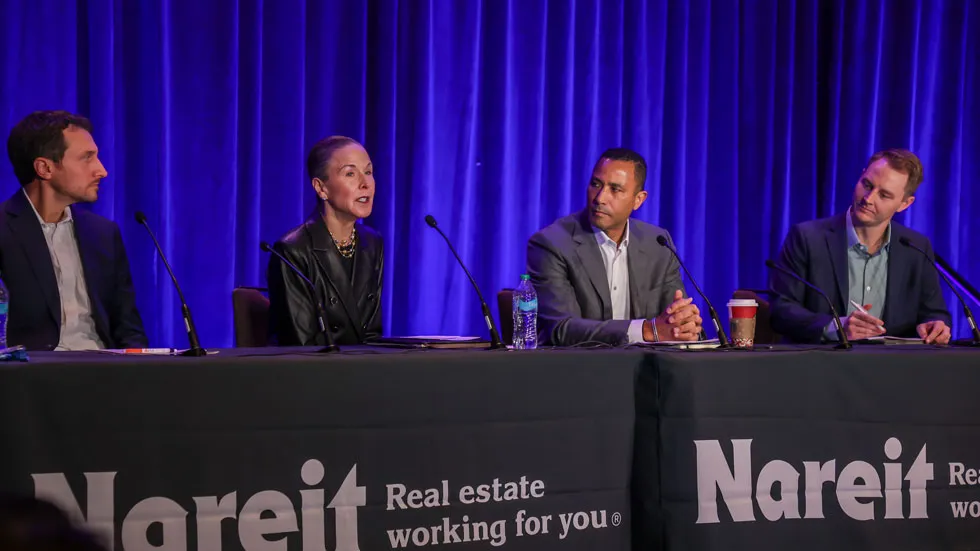
Mike Cordingley, managing director and head of strategy and leadership advisory at Ferguson Partners, moderated the discussion. Participants included Kelly Barrett, board chair at Piedmont Realty Trust (NYSE: PDM); Nick Joseph, head of the real estate and lodging team and the global real estate super sector at Citi Research; and Charles Young, CEO at Sun Communities, Inc. (NYSE: SUI).
For boards, effective succession planning begins with establishing a clear understanding of the qualities a CEO needs to lead a particular company. Barrett, who has also served as CFO at Cousins Properties (NYSE: CUZ), emphasized that no candidate will be completely prepared for the role. Instead, directors should determine what constitutes being “ready enough” and assess candidates against that standard.
She suggested that companies develop a CEO skills matrix, similar to the frameworks used to evaluate board directors. Such a matrix can help boards identify leadership requirements early, assess potential successors, and address gaps through targeted development opportunities.
“There's nothing more critical,” Barrett said of succession planning, emphasizing that identifying the right candidate is a board’s number one responsibility. “If you don’t have a succession plan, you’re significantly behind the eight ball,” she added.
Ferguson research presented during the discussion showed that roughly seven in 10 new REIT CEOs between 2021 and 2025 were promoted internally, with many coming from COO or CFO roles. Nearly 85% came from real estate backgrounds. However, financial acumen and industry knowledge are increasingly viewed as baseline qualifications rather than distinguishing characteristics.
Instead, boards are placing greater emphasis on people leadership, self-awareness, judgment, and the ability to communicate a compelling vision.
CEO as Coach, Team Builder
For Young, who stepped into the CEO role at Sun Communities in October 2025, the transition reinforced the importance of combining confidence and conviction with a willingness to learn. He described three foundations for leadership: confidence in one’s abilities, conviction to navigate uncertainty, and a clear vision that can evolve as circumstances change.
He also highlighted the importance of listening and learning before making significant changes. During his first 14 months, he visited 50 to 60 communities, meeting employees and learning about the organization while identifying opportunities to build on its existing strengths.
That approach has helped inform Sun Communities’ strategic direction, including a focus on its manufactured housing and RV businesses and the opportunity to expand professionally managed single-family rentals. He also identified a need to challenge outdated perceptions of manufactured housing and communicate its role in addressing the country’s growing need for affordable housing.
Young, who played football at Standford University and spent several years as a professional football player in the National Football League, sees the CEO’s most important responsibility as developing people and building a team capable of executing the company’s strategy.
“The most important role as CEO is coach,” he said, describing the need to attract, retain, and develop talent while empowering employees to make decisions aligned with the company’s vision. Barrett agreed with Young’s approach, stating that “if you don’t have the right team, you can’t be a success.”
Communication and Investor Confidence
Meanwhile, the changing REIT investor base is reshaping CEO responsibilities. Joseph at Citi noted that generalist investors have become increasingly important drivers of REIT performance over the past decade.
As a result, REIT leaders must communicate effectively with a broader investment audience, clearly explaining their growth strategies and how per-share growth and dividends contribute to shareholder returns.
Succession announcements are an important test. A well-telegraphed transition can give investors time to become familiar with potential successors, while an unexpected departure often raises questions about the company’s direction. Investors want to understand what will remain consistent, what will change, and how decisions involving capital allocation, business operations, and management will evolve.
New CEOs must also balance investors’ desire for immediate answers with the need for time to make informed decisions. Young recalled meeting with investors just six weeks into his tenure, when questions about asset purchases, share repurchases, and international operations demanded clarity before he had completed his assessment.
Being transparent about the decision-making process, he explained, can help build confidence while allowing a strategy time to take shape.
Start Early, Prepare for the Unexpected
Boards face practical challenges in maintaining a pipeline of potential successors, particularly at REITs with their lean management structures. Still, the panelists agreed that succession planning cannot wait until a CEO announces a retirement or an unexpected departure forces an urgent search.
Directors should give candidates stretch assignments, evaluate how they respond to unfamiliar challenges, and seek feedback on how they work with employees and other stakeholders. External candidates can bring valuable perspective, but they also require careful assessment of their cultural and professional fit.
For aspiring CEOs, Young encouraged taking on increasingly challenging roles, developing future leaders, and learning to manage more than a business’s financial performance.
Ultimately, successful succession depends on preparation, trust, and the courage to make difficult decisions. As the panelists emphasized, no leader will be entirely ready for the job. The goal is for candidates to have the experience, relationships, and judgment needed to step forward when the opportunity arrives.